Mexican History, Part II
(_Collaborative thread:@AlexGarcia , @LNSS and @Chat-Nihiliste .)_
Excerpts from multiple presentations made at the “National Forum: 80 years since the triumph of the Revolution” in 2014.
Presentation 1: The three-way war: Cristeros, Callistas and revolutionaries,by Hector “Pedro” Ochoa
Something that many modern historians forget, either out of ignorance of the conditions in Mexico during the 1920’s to the 1940’s, or out of frank historical revisionism to favor their personal interests, is the indirect help that occurred between the reactionary guerrillas of the Cristero movement and our joint revolutionary movement. It may sound strange, but there is a strong forgotten truth: without the Cristero movement weakening the military capacity of the Callista Army, our revolution would have suffered many more setbacks than it did originally. That doesn’t mean that we should thank the Cristeros for their contribution to the Revolution. Their help was more a mere coincidence that benefited us in the end, it was not the result of a mutual understanding or an alliance; in other words, “the enemy of my enemy is not necessarily my friend”. Another factor to take into account in the separation of the contemporary Cristero movement from Zapatismo and, in general, from revolutionary agrarianism, which logically also ended up benefiting our struggle for the Second Revolution and its consolidation.
In this context, three political and ideological tendencies emerged within the agrarian movement of the time: the revolutionary, based on Zapatismo; the pro-government, a base of peasant support for the Callista government; and the Cristero one, led by landowners, clergymen and reactionary members of Mexican society. The first two groups were initially more or less de facto allies, in the face of what both groups considered a reactionary and anti-revolutionary threat. However, the Zapatista experience in Morelos, considered by many as a success, and Zapata’s own radicalization towards Marxism (together with the slow but progressive appearance of the PCM in the political life of the country) ended up provoking the supremacy of the first group over the other two. The Callista agrarists didn’t had the same popularity and charisma as Zapata and Co., and although they uniformly defended a modernization of the productive methods in the countryside since they considered both the traditional productive models of the haciendas and the peasant communities as something inherently backward, they didn’t managed to break ideologically with nationalism and with it the idea of class collaboration, making their proposals, although sincere, insufficient to solve the problem in the best of cases or, in the worst of them, they became new landowners, with many of them ending up as bureaucrats who delayed land redistribution and agrarian reform for as long as possible; which benefited the Zapatistas, who were much more sincere, direct and effective thanks to the experience accumulated by decades of peaceful or armed militancy. Besides, as Zapata and General Villa were by that time friends and comrades, both had great mutual esteem and trusted each other for what had to be done, so Villa didn’t support the Callista side in the agrarian movement, which for some people ended up sealing the fate of the Nationalist government.
But to understand exactly how the Callismo movement ended up being devoured from both its left and its right, we must first delve into the formation of the Cristero movement in the 1920’s. As we well know, the post-revolutionary era disappointed thousands of its participants, which led them to embrace radical left and right policies, particularly due to the promotion of anti-clerical (but not precisely atheist) policies that led to the crossing of bloody dividing lines. The policies of both the bourgeois governments of Obregón and Calles angered many leaders of the Catholic Church, who, as we well know, feared that the peace pacts between the so-called “Sonora Group” [1] and the agrarian forces of Villa and Zapata would give rise to a new revolutionary order, so they chose to mobilize with the other major group threatened by the 1910 revolution: the rural aristocracy, fearful not only of the ideological growth of Zapatismo among their serfs, but also of the recent experience of terror by Villa’s forces in the northern semi-desert plains of the north of the country. So they were quick, first, to call on their followers to oppose “the rise of international communism” by employing violence and, second, to bolster a number of Catholic organizations to give it an ideological veneer with which to attract both the old defeated but not destroyed Porfirian forces and former revolutionaries disillusioned by both the Callista turn of the revolution and also by the apparent lack of victories of the Zapatista and Villista forces, who, to make matters worse for these individuals, little by little slipped into the PCM camp, giving a certain popular legitimacy to the Cristero guerrillas in the areas where they became strong.
The final excuse, which provoked the uprising of the Cristero rebellion, was the application of the Calles Law [2]. This triggered the leaders’ decision to take up arms. This rebellion, carefully planned from the Vatican, counted on officers from the old Porfirian army, was generously financed by Catholic landowning families who sent their sons to serve in its ranks, was reinforced with former revolutionaries who didn’t join either Calles or Zapata and had popular support because the power of the church in the countryside allowed hundreds of parish priests to order their flocks to join the Cristiada to serve as cannon fodder.
As for the Cristeros, although many had no plan to solve the agrarian problem beyond the blind belief that a Catholic government would solve all the country’s problems, they managed to keep their militants in line not by their own merits but by the excessive cruelty of the Callista forces sent to fight against them: girls and women of all ages sexually assalted, indiscriminate massacres, public tortures, profaned places of worship, etc. This led to the consolidation of Catholic ideological control in the Bajío and the West of the country due to the indignation and fear of being the next to be assassinated, the calls for revenge, and the rejection of any peace pact given from the pulpits of hundreds of rural and urban churches.
If the Catholic rebellion didn’t managed to spread further it was because many peasants had made the Zapatista slogan “The land belongs to those who work it” (La tierra es de quien la trabaja) their own, as well as the slow emergence of class consciousness among peasants who saw no reason to join a movement led by the old ruling class, therefore, in areas where the power of the Catholic church had been broken or weakened (i.e., those areas where armed agrarianism had been in decline), the Cristero proclamations to form peasant guerrillas went largely unnoticed and while a few urban groups attempted to organize rural sheaves, their inability to dialogue with the peasants and offer a viable alternative to Zapatismo led them to alienate thousands of Catholic peasant families.
[…]
Eventually, both Cristeros and Callistas found themselves at a total disadvantage in the face of the popularity of Zapatismo, which was increasingly closer to Marxism. Hence the fruitless negotiations between the National League for the Defense of Religious Liberty (Liga Nacional para la Defensa de la Libertad Religiosa, LNDLR) and the Callista government began. Logically, everything ended in failure. One of the rumors for which it is currently believed that none of the parties reached an agreement was due to the reluctance of the U.S. government to impose pressure on Calles [3]. By the time Calles finished his presidential term in 1928, the situation for the Mexican Army was, although not terrible, bad: the lack of support from the Zapatistas and the lack of knowledge of the terrain caused serious setbacks for the Army, which had to give all its efforts to contain and defeat the Cristeros, who opted for the use of guerrilla tactics to defend themselves and cause progressive damage to the Mexican government.
Ironically, the alignment of the peasants in the Zapatista-led zones; and the desperation of the Callistas to keep both groups at bay, was the perfect breeding ground for the formation of Cristero strongholds that took over the entire countryside around cities such as Guadalajara, Morelia and Guanajuato. Pitched battles between laymen against Cristeros were the everyday’s bread , and for a time part of the states of Jalisco, Nayarit, Guanajuato, Querétaro, Oaxaca, Guerrero and Michoacán were under total Cristero control, from which they were able to maintain a position, if not good, at least stable enough to resist both the Zapatista influence in the region, and the diplomatic and military attempts of Calles and his successor to defeat them (or align them to his cause). The accumulated attrition of the Mexican Army resulted in the de facto seizure of places by the Cristero Army that destroyed any other social and political structure that was not controlled by the local parish priest, which allowed a later expansion of their consolidated territory over Aguascalientes and Zacatecas. On the other hand, in other states, the Cristeros were destroyed, either by the increasing repression of the Mexican governmental apparatus or by the consequences of the First Revolution, that is, by the terror launched against parishes and priests in Villista territory, which saw its counterpart in Zapatista territory where, thanks to a series of pragmatic policies, they had managed to reconcile Catholic customs with the call for agrarian distribution.
Despite the efforts of the nascent National Revolutionary Party (Partido Nacional Revolucionario, PNR) to deal with the Cristero issue, it could be said that it was already too late. To make matters worse, once the Great Depression began, many businesses, both national and private (generally benefiting from the economic connection between Mexico and the United States) collapsed, so the government entered a continuous path of failure, where no one knew exactly how to deal with the economic crisis. The new president, -who had come to power thanks to General Calles having organized an electoral fraud against his adversary José Vasconcelos- Pascual Ortiz Rubio, tried to safeguard the economy as much as possible, diverting resources that could have been used to contain the Cristeros and Zapatistas. From this point on, the Great Game between the Cristeros and the Zapatistas began, to see who would take better advantage of the collapse of the Mexican State. […]
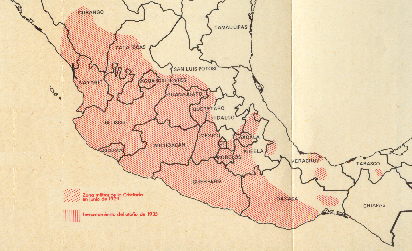
Area of principal Cristero activity during the Cristero War. CREDITS: College of Liberal Arts of the University of Texas at Austin/Elizabeth Garcia and Mike McKinley. Link.
Presentation 2: From peasant guerrilla warfare to mechanized warfare: The military and political development of Zapatismo and Villismo, by Tiburcio “Francisco” Cruz Sanchez
The history of Zapatismo and Villismo in Mexico can be considered, to a certain extent, the history of our revolutionary government. Both armed groups, which had already been defeated during the 1st Revolution, emerged as victors of the 2nd Revolution, and although they didn’t obtain the total hegemony of the revolutionary movement, they did give it an important base. This is why it is necessary to study the military and political failures and mistakes in historical-chronological order of both movements, as well as the way in which both overcame such errors to strengthen themselves and in aid of the other.
[…]
During the 1st Revolution, there were many factors that we could say frankly that although they helped the consolidation of Zapatismo in the south of the country, they also prevented its ideological and military expansion beyond the populations that had been part of the agrarian project before the war: on the one hand, we have the already known charisma of General Zapata, the Caudillo of the South (Caudillo del Sur), beloved by the peasants and defender of the poor. This charisma was reinforced by a correct application of guerrilla tactics that derived in strength, criticism and self-criticism within the generals of the Liberation Army of the South (Ejército Libertador del Sur) that allowed them to face (more of less) the Porfirian army despite their clearly disadvantageous situation. However, the material advantages of the troops loyal to Diaz and Huerta would be lost once the US decided to support Madero and later Carranza, and this loss of material advantage was aggravated by the multiple military fronts these forces faced, this allowed the Zapatistas to consolidate their positions in the entire state of Morelos, as well as parts of the states of Guerrero, Mexico, Puebla and even for a time, occupied Mexico City. This situation would be key in the following years, both with regard to the Cristero conflict, the emergence of revolutionary nationalism and Callismo , as well as the theoretical formation of Zapatismo as a Marxist (or libertarian, depending on the point of view of some) current.
Within the Zapatista effort to stop the Carranza’s government, we can enumerate different characters now considered strategists, who learned to form themselves on the battlefield and in the political field, the hard way:
-
Amador Salazar : General Salazar, born in Cuernavaca, was a signer of the Plan of Ayala. As we well know, he is considered one of the most important strategists of the 1st Revolution, responsible for keeping the Carranza government at bay during the 1915-1916 offensive. However, his efforts were disarticulated when Carranza managed to retake Mexico City from Zapatista control. As fate would have it, he survived an assassination attempt on his life in mid 1916 [4], and, knowing that the situation was uncomfortable for the Liberation Army, he proceeded to reorganize the Zapatista forces around the territories still under his control, and to convince Zapata to be more inflexible and harsh against those suspected of treason or defeatism. After the war, he became a Marxist sympathizer and thanks to the intervention of the PCM he received a scholarship to travel to the Soviet Union to take military classes under the direction of Mijail Frunze. Specializing in guerrilla warfare and encirclement operations, Salazar swore to himself not to repeat the failure of the counteroffensive on Mexico City in 1916. Returning to Mexico, he gave lessons to other future generals on what he had learned in the USSR and personally discussed battle plans with Zapata, Villa and Fierro (with whom he would become close friends), whether regarding what past battles might have been, or future possibilities.
-
Eufemio Zapata: Emiliano’s older brother; an arduous advocate of agrarian distribution, which he headed and supervised in Morelos and southern Puebla, especially known for his work in the city of Cuautla during the period of the so-called Morelos Commune. Like Amador, Eufemio was characterized as someone who sought to adapt to circumstances, but, equally, he had personal problems. Amador could be considered as someone who was impulsive; Eufemio on the other hand was an alcoholic. In mid 1917, Eufemio suffered an altercation with General Sidronio Camacho, which almost cost him his life [5]. However, Sidronio would be executed by the joint forces of Amador and Genovevo de la O, who acting in accordance with Emiliano’s order to search and capture possible traitors, deduced that Sidronio was a deserter. Eufemio, grateful to be alive, quickly adopted a more serene attitude and gradually decreased his alcohol consumption. After the war ended, Eufemio was part of the Zapatista delegates who traveled to the north of the country every few months to meet with their Villista counterparts, having special contact with Felipe Angeles, General Villa’s controversial kid glove. It is thanks to Eufemio’s efforts that the Zapatista troops would manage to develop a logistical capacity with which to feed military operations in addition to clarifying their tactical and strategic vision.
-
Manuel Palafox: The black bird of Zapatismo ; Mr. Palafox is recognized today as the diplomatic representative of the Liberation Army of the South, as well as an important politician and administrator. Hated by the American bourgeoisie of the time, Palafox was quite direct in his comments and actions, redistributing land and factories, whether local or foreign, to rural people. Known for his administrative management in Cuernavaca (along with the help of other future politicians such as Felipe Carrillo Puerto or Antonio Díaz Soto y Gama), Palafox earned a place in the Revolution as the negotiator between Emiliano and the politician Emilio Vasquez Gomez. One of the authors of the so-called Manifesto of the Nation (Manifesto a la Nación) of 1916, Palafox was especially important after the war to act as an intermediary between, in the first instance, the Zapatista movement with the Mexican and American labor movement and later to be the main negotiator with the war-weary Synarchist rank and file, along with his wanderings in the UASR as ambassador and his later support for the Mexican Cultural Revolution, that although interesting, are not relevant to this presentation.
-
Genovevo de la O: Genovevo is known not only for belonging to the Magonista wing of Zapatismo but also for discovering Francisco Pacheco’s plot. De la O suspected Mr. Pacheco of being a traitor. At the beginning of March 1916, Pacheco was ambushed by a patrol of militiamen, subordinate to Genovevo, and was taken prisoner. He was accused of constantly incongruous attitudes, including insanity, but he was considered to be a deserter, so he was removed from his post. Although Zapata was not happy with the decision, Genovevo justified his actions by alleging Pacheco’s erratic troop movements, which threatened to leave the way open for the Carrancistas to besiege Cuernavaca. He was famous during the war for his intransigence, hatred of cities and deliberate destruction of all infrastructure, including haciendas and railroad tracks. After the war he acted as a politician rather than a military man, often as a negotiator between the governments in Mexico City and Morelos, Zapatista territory. His ability to discern small details in individuals led him to become part of the nascent intelligence services after the 2nd Revolution with the negative consequences for the POLN that we all know. He died in 1952, shortly after General Zapata, but not before - like many other ex-Magonists - becoming a founding member of Lombardo Toledano’s PPS.
Photos of the aforementioned generals: Amador, Eufemio, Manuel and Genovevo. CREDITS: Wikipedia.


[…]
During the period between revolutions, contacts between northern and southern Mexican movements were diverse. Previously, the frictions between the Villistas and Zapatistas, although not too many, forced the search for concessions, or simply, a disagreement. During the Convention of Aguascalientes, both groups clashed especially over the indigenous question and the degree to which the agrarian reform should be carried out. Similarly, while the Zapatistas were characterized by (to some extent) a mixture of pragmatism and idealism, the Villistas were rather orthodox and overly realistic, to the point that they were viewed with fear by other revolutionary factions, particularly in the case of the Magonistas who always saw the Villistas, first nationalists and later Marxists, as their greatest enemy. It was not for nothing that the territories under Villista control would be considered especially dangerous by the Cristeros: the Mexican red terror would find its maximum expression there. To a certain extent, what Calles could not, ended up in the government of the Socialist Republic: the pacification of the country, by negotiation…or annihilation.
The meeting points between the two factions would take more or less a syncretic turn as a result of the trips undertaken by Zapata to Villista territory, and vice versa. The PCM was just taking its first steps as the vanguard party of the Mexican working class; and the Magonista movement was recomposing itself in the United States and Baja California.
While all this was going on, Zapata was analyzing battle strategies in the northern part of the country, accompanied by General Angeles and Eufemio, his brother, who complemented each other and saw the mistakes of the past as something that should not be repeated. Emiliano, on the other hand, thought of the personal mistakes he made and could have avoided: his impulsiveness, his drunkenness, his lack of knowledge about military logistics. The Convention failed because Zapata’s distrust of the former federal army officers, turned into fervent villistas, who advised expelling Carranza from Veracruz while they had the military thrust, which Zapata ignored to focus on the agrarian distribution in Morelos. The offensive against Puebla had failed because Zapata’s peasant army had been exhausted in its march and subsequently didn’t even attempt to rule Mexico City when his troops occupied it, and while the so-called Morelos Commune, hailed by the Mexican anarchist movement, flourished for a time, Zapata knew that this had only been possible because Carranza was too busy fighting Villa and his comrades, despite the physical proximity between Mexico City and Cuernavaca. In other words, Morelos was considered a minor problem by the bourgeois generals. Had it not been for Villa’s strategic astuteness, the Northern Division would have succumbed. And then, the Morelos Commune would not even have been able to flourish. Zapata decided that there would be no need to fear again, that surrender was not and would not be an option.
Flag of the Morelos Commune during its existence. The words, in English, say Land and Freedom. CREDITS: Wikipedia.
First flag of the Zapatista movement, during the period between revolutions. The words are the same as above, Land and Freedom. The symbol is a machete (peasant symbol) crossed with a Winchester Model 1894, better known in Mexico as the .30-30. The flag will change according to the radicalization of the Zapatista movement to Marxism, with several variations.


This awareness of military disasters went hand in hand with Zapata’s own ideological evolution. In reality we can speak of three Zapatismos during the 1st Revolution: the first was a liberal Zapatismo , product of his education and the bourgeois-democratic and nationalist values to which he had been inculcated, but this liberalism with a social focus died with the offensive that Madero sent against the communities of Morelos; the second Zapatismo is actually a consequence of the first, quoting Gramsci, “in the dialectic of ideas anarchy is a continuation of liberalism, rather than socialism”[6], so the Zapata who already had a strong communitarian vein and had a liberal background as a result of reading Magonist texts evolves to a form of anarcho-communitarianism for the management of the Morelos Commune, but the numerous limitations of this model that (as we have already mentioned, could only be sustained due to the fact that the communities of Morelos were not able to sustain it, and only persisted due to the fact that Carranza’s bourgeois troops were busy fighting in other parts of the country) led to the fact that even in its period of apogee there were many internal struggles and caudillismo, so that a third Zapatismo appears in the last years of the 1st Revolution, when the winds of the Bolshevik revolution reached Mexico, making Zapata, completely alien to the workers’ struggles, begin to take an interest in a worker-peasant alliance [7].
In reality, Zapata already had contact with agricultural workers, but these workers were essentially petty bourgeois from an ideological point of view, they didn’t wanted the socialization of the land but an agrarian distribution to become small landowners themselves, Zapata on the other hand had experienced for himself the virtues and limits of the anti-capitalist strategy of the Mexican peasantry: they could build organizations independent of the bourgeoisie and govern themselves through peasant democracy, but they were incapable not only of putting at their service the little industry in their power but also of overcoming their political fragmentation since this model of resistance was only possible in areas culturally akin to the peasant communities of south-central Mexico; the failures of this regional peasant government easily explain the inherent immediacy not only of the agrarian peasant struggles but also the fragility of the military offensives of the Morelos Commune, dependent on its caudillos, its agricultural cycles and its tactical capacity completely detached from any long-term strategic considerations. This explains in more than one sense why the Liberation Army of the South of this period never managed to outline a political program that was attractive to the working class.
Zapata, thanks to his closeness to the PCM, was willing to correct this mistake thanks to the influence of Leninist thought which allowed him to reformulate his ideas to include not only the agrarian distribution but also the workers’ problem, the reorganization of the economy and the need for a revolutionary proletarian-peasant government, in the countryside Zapata affirmed that the peasant government would no longer defend the right of individual property but would abolish the bourgeois character of the economy. Zapata, although he didn’t sympathized with the Marxist-Leninist methods that the VKP(b) had implemented in the countryside, he understood and shared their motivations; he was definitely not a Bukharinist as the PPS militants tried to make him out to be: already during the Commune both he and Palafox tried to stop the individualist tendency of the peasantry that not only tried to destroy the rural factories but also generated a tendency of new accumulation since many of these peasants sought to maintain capitalist relations, generating new inequalities [8]. In the intermediate years between the two revolutions Zapata’s incipient Marxism had deepened, proof of this was the initial publication (there will be future reeditions with the help of Villa) of his most famous book, The Revolution and the Peasant [9], where he defended in it the thesis that the only way in which the revolution would give full justice to the working masses of the countryside and the city, as well as in the non-industrialized countries, would be a proletarian state in transition to socialism where industry would be expropriated and the economy would be planned under a democratic dictatorship of the workers, which would be the first step of the international socialist revolution (in the book the strategy of the so-called People’s War is mentioned for the first time)
[…]
Doroteo Arango, or General Francisco Villa, as we know him today, was not exempt from problems either. His movement and his Army survived Huerta and Carranza, but the sacrifices made were too much. Our advances in mental health have considered the possibility that, in their later years, at least a quarter of the Northern Division suffered from post-traumatic stress disorder and in the interwar years many of them suffered from severe depression, even calling themselves “burnt cartridges” because they felt that the struggle had been a waste and that nothing had been gained after long years of war. Although this discouragement was natural, Villa made many efforts (several of them unsuccessful) to counteract these thoughts that he secretly also shared, as a consequence of the bloody campaign in the 1st Revolution (which would be repeated with even greater viciousness in the 2nd Revolution). Villa felt to some extent disgusted and anxious about the scenes he witnessed or starred in during his best years, developing a great self-hatred that was only tempered with the subsequent triumph of the American and Mexican revolutions, as for example, the rumor that he had cried publicly at Madero’s funeral and later, when John Reed came to power in America: when he learned that the journalist who had narrated some of his greatest campaigns was now leader of the northern neighbor he wept for joy in front of thousands of his followers, losing much of the weight that had been on his shoulders (it is also said that he cried and promised bloody revenge when he learned of Stalin’s death, but that is beside the point). Moreover, it is no secret that, due to his own living conditions, Villa had attitudes that today we know to be degrading: sexism, homophobia, racism. The most particular case was his contempt against the population of Chinese origin. His lieutenant, Felipe Angeles, didn’t look favorably on the indigenous people (although he would later admit his mistake). Not to mention the many children he had with several women. That reactionary and disastrous legacy would not leave him in peace until his death, even in spite of the policies of reparation and rehabilitation in the post-revolutionary period.~~~~[Hello, Alex here, consider this as non-canon anymore]
In military matters, Villa saw with certain surprise and sadness the apparition of cars in the country: surprise because of their resistance capacity and possible military uses; sadness because he could not used them in due time and thus, save the lives of so many men who perished during the cavalry charges to counteract the Carrancistas. He was a good strategist, but not very charismatic and we can certainly accuse him of a certain insensitivity towards some of his followers.
[…]
For his part, like Zapata, Villa was accompanied by his own generals without whom it would be impossible to understand this period where the class struggle was particularly fierce:
-
Felipe Ángeles: The so-called Silk Glove of Villismo, probably one of the most brilliant students of the College of Chapultepec and later not only one of the greatest artillery experts in Mexico but also a critic of Porfirio Diaz. Appointed director of the Military College during the Maderista period, he was commissioned to fight both the Orozquistas and the Zapatistas. It was in the fight against the Zapatistas where he refused to maintain scorched earth policies and tried to dialogue with Zapata to peacefully resolve the conflict, although this was not achieved, but at least he obtained Zapata’s respect and admiration. Apprehended together with Madero during Huerta’s coup, he was sent into exile to return in 1913 and join the Constitutionalist ranks. Carranza, who distrusted his democratic policies, sent him to join Villa to serve as his chief artilleryman, serving in battles such as those of Torreon and Zacatecas, it was in the latter where he demonstrated not only his talent but also where he broke the back of the old Porfirian army. It was in the battles of the Bajío, where the Obregonistas defeated Villismo , that led him back into exile, since Carranza’s moral character repulsed him. It was in his 2nd exile in the United States where he adopted Marxism in its social democratic variant and decided to return to Mexico to continue fighting for a Marxist revolution. It was only when he discovered Felix Salas’ betrayal that allowed him to survive and be amnestied together with Villa at the end of the 1st Revolution. A few months later he joined the PCM where he continued to evolve his political thinking and began his friendship with the Zapatista generals, improvising a military school in the backyard of Francisco Villa’s house. Together with other Villista generals he joins the 2nd Revolution participating in the equally important 2nd Battle of Zacatecas and later becomes again the director of the renewed Revolutionary Military College of Chapultepec.
-
Rodolfo Fierro : nicknamed “The Butcher” (El Carnicero), if Ángeles was the silk glove of villismo, Fierro was (never better said) the iron gauntlet. He was a railroad worker before joining the villista troops where he was soon promoted due to his fearlessness and loyalty and although he was not a brilliant tactician his suicidal courage compensated for the lack of adequate military preparation [10]. This, coupled with his fanatical loyalty to Villa, allowed him to rise quickly through the revolutionary ranks, taking charge of the villista terror: the systematic destruction of the old landowning aristocracy and the Catholic clergy and the confiscation of the wealth of these groups to finance the revolutionary war. He was known as someone who showed little emotion except for the pleasure he took in violence and murder, someone with no particular empathy but with an uncompromising disposition and a hatred of the privileged elites of the north of the country that made him extremely reliable for the cause in those turbulent years. After the defeats of Villismo in the Bajío he barely survived the battles where he learned that pure willpower could not aspire to conquer positions defended with barbed wire and machine guns, and that the era of war on horseback was over. Together with Villa he spent the last years of the 1st Revolution as a guerrilla fighter until the amnesty of Obregón and De la Huerta. In the years between the wars he became friend of General Salazar and the PCM militant David Alfaro Siqueiros, and together they devised the strategy of occupation of trains and motorized mobile forces using civilian cars with improvised armor and the use of machine guns to surround and decimate the Callista troops with great success. His dark fame rose to new levels in the war against the Sinarquistas and against the integralist troops. After Villa’s death he transferred his loyalty to José Revueltas with the results we all know.
-
Candelario Cervantes : outstanding Villa’s general and perhaps one of the greatest experts in guerrilla warfare within the ranks of the Northern Division, from a very young age he had joined the opposition to Porfirismo. Although he didn’t have an outstanding performance during the most important battles of the Northern Division, where he participated as another golden man, it was in the long years of guerrilla struggle in the Chihuahua mountains where he gained Villa’s trust and esteem. In fact, it was the trusting relationships he achieved with the Chihuahua peasant populations that allowed Villa to have a rural support base for his long guerrilla war. He was amnestied together with Villa and distanced himself for a few years as he focused on the political struggle, even seeking to be elected in local public positions without success despite his popularity among the agrarian population. It was finally his reading of the renewed Zapatista thought that brought him closer to Villismo and with it he became one of the champions of the agrarian distribution in the north of the country. His participation in the 2nd revolution was to command the mobile guerrillas that harassed the rearguard and the supply lines of the Callista troops, this last war on horseback would be for many the swan song of traditional villismo before the total adoption of Jeeps and motorcycles, later he would become Palafox’s right hand in the negotiations with the Sinarquist peasant communities angered with the war to convince them to accept a peace with honors, retiring from public life soon after.
-
Toribio Ortega : another outstanding villista leader who like many others had spent his first years as an opponent to Porfirismo , with time he joined the villista troops where his bravery and ability earned him the rank of brigadier general participating in numerous battles before falling ill of typhoid so Villa sent him to recover in Chihuahua, not participating in the military defeats in the Bajío [11]. He rejoined the villistas during the guerrilla period and his popularity and ease to be loved by the population allowed the villismo to continue to be supported by the population. Strongly encouraged by Felipe Angeles, he was one of the first villistas to join the PCM and became an outstanding agrarian and union organizer, putting his military experience at the service of José Revueltas to organize the armed insurrections in the cities that were to be complementary to the guerrilla combats in the countryside. This war strategy allowed the unions to take over large industries but more importantly, the railroads that would later transport the villistas and communist troops. After the triumph of the revolution he continued fighting against the Sinarquistas in Sonora and Sinaloa and commanded troops against the Integralists. He would end up dying in his hometown (Coyame) in the middle of a multitudinous dance.
The aforementioned generals: Felipe, Rodolfo, Candelario and Toribio. CREDITS: Wikipedia.


[…]
Villa had already known the social perspective of Zapata’s project in Morelos, which he partially criticized. Already in the 1st Revolution, together with Fierro, he had mercilessly crushed the Magonistas who in the Plan de la Empacadora[12] (better known as the Orozquista Plan) defended the program of the Mexican Liberal Party. Due to the exile of Ricardo Flores Magón and most of the PLM leadership to the United States, and, therefore, without a coherent leadership, the surviving anarchists in northern Mexico had incorrectly concluded that Huerta was the lesser of two evils and had joined their fate to that of El Chacal , being known as the Colorados (because of the color of their red and black shirts and flags). Villa deeply despised them and saw them even worse than the federal Huertista troops, for while the Huertistas were the enemy (and many of the federal soldiers were conscripts, forced to serve Huerta’s government) the Colorados were traitors of the worst kind (and, besides, they were volunteers and not conscripts), maintaining that contempt over the years, even when Villa abandoned social patriotism to embrace Zapata’s vision of Marxism. In general, Villa’s strength was military but not political or ideological, until he was forced to learn more about his northern neighbor. In contrast, the still young Emiliano was fascinated by the development of socialism in the United States, after all, he was overjoyed by the Bolshevik Revolution and was now a reader of Marx and Lenin. His strength was political, but not military.
Each one required something the other didn’t have. And, with the 1st Revolution over, the trips to Morelos and Chihuahua became more and more frequent. Zapata needed to learn and develop the concepts of war, and Villa wanted to redeem his past by repeating his performance but now doing it better.
Presentation 3: The National Synarchist Union and the ideological roots of Mexican Fascism,by Ignacio Arturo “Oseas” Salas Obregón
In order to understand how Synarchism as a movement and ideology could become a serious threat to the revolutionary state that emerged from the triumph of the popular forces in 1932-1934, it is necessary to understand two parallel and closely linked phenomena: reactionary Catholic thought and Mexican nationalism, which converged to create an organization that would put the revolutionary authorities in check for many years. […]
It was during the last years of the Porfirian regime when Catholic associations were founded under the anti-socialist directives of Pope Leo XIII who began to organize welfare societies for those Mexicans who, in poverty, remained loyal to their Catholic faith; these societies fostered mutual aid societies. Later, an important group of these Catholics radicalized their position and considered reforming the whole society through religion, leading them to found numerous religious organizations to promote a Catholic model for the Republic, and taking advantage of the Maderista situation to organize a party that represented Catholic interests in such a way that in 1911 the National Catholic Party (Partido Nacional Catolico) was founded, which after Huerta’s uprising joined the coup government under the perception that it would be the best for Catholic interests.
This collaboration was the reason why the party didn’t survive Huerta’s defeat at the hands of the revolutionary armies, who punished Catholic political militancy by including in the 1917 Constitution the prohibition of political parties with references to any religious confession in their names, which, together with several articles of progressive orientation and with a certain social justice content, gave the perception to these sectors that the 1st Revolution was essentially anti-Catholic. During the following years the relationship between the Catholic Church and the post-revolutionary state was not the best and had numerous moments of great tension and physical violence, as a result of the intransigent and fanatic clerics opposed to any change, who initiated the formation of groups such as the LNDLR or the Catholic Association of Mexican Youth (Asociación Católica de la Juventud Mexicana , ACJM), who played an important role before, during and after the Cristero War as representatives of the urban intellectuality of the Cristero movement.
As the Catholic historian Jean Meyer points out, the so-called cannon fodder , the contingents of Cristero combatants, originated not in the middle strata of the urban petty bourgeoisie (who monopolized the story of the war, presenting it as a crusade in defense of a faith persecuted by a tyrannical government), but among Mexican peasant groups, the great losers of Mexican history, whose living conditions progressively worsened as the years went by and to many of whom the revolution didn’t do justice, on the contrary, it accumulated the list of injustices for them, where modernity had not been a source of welfare but of redress, in a continuous history of abuses born from the Spanish Conquest and with their communities devastated to impose a program of unequal and superficial development while identifying the indigenous past with barbarism. With many of their demands defeated and many of their leaders assassinated or co-opted, without political instruction or an organization of their own to represent their class interests, faith became their bastion, their defense. United around the figure of Christ, promoted by the Catholic Church as an alternative to the secularized and laicist state emanating from the 1st Revolution, they would fight for an order directed by religious norms, and would attack with fanatical dedication against their enemies.
Cristero family during the war, with a modified Mexican flag, in which the Virgin of Guadalupe can be seen. CREDITS: Latin American Studies.

Before continuing, it is fair to mention that Meyer is a writer with a clear commitment to the Vatican, so that on more than one occasion he has been accused of hiding important data directly linking the Vatican to the religious insurrection of the Cristeros through the Mexican Episcopate while avoiding paying attention to the fact that the Cristeros -ideologues and combatants- lend themselves to calling themselves “counterrevolutionaries” and see the post-revolutionary state of Calles as inspired by Marx and Lenin. There is no mention of the economic interests of the self-declared Catholic organizations and their opposition to the concessions given by the Calles regime to the workers’ movement of the PCM and Zapata’s peasant movement, presenting instead the conflict between the laity and the religious as inevitable because of the wickedness of the former, he minimizes the relations between the LNDLR and the Cristero army, since the League’s ambition was to seize power, organizing a military committee and even a draft constitution that had the support of Cardinal Pietro Gasparri, Vatican Secretary of State. He avoids explaining the reactionary character of the leaders of the League not only in the religious aspect but also in the economic one, he lies when he states that the Cristeros didn’t represent the interests of the Mexican landowners -they used the adjective “Bolsheviks” to all their enemies, from Calles to the agrarian peasants who benefited from the Revolution- and he minimizes the hatred that the Cristeros had against the revolutionary agrarian militias organized by Zapata. The same is done when he presents the Cristero leaders as popular leaders, when a good part of the old aristocracy of the “good families” of the center and western parts of the country were part and leader of the Cristero movement and a few years later of the Synarchist movement.
Returning to the main point, there is already something in this uprising that we can clearly describe as proto-fascist; if Benito Mussolini himself described fascism as totalitarian, its system in which there is no human or spiritual value above the State, perhaps the Cristeros who fought in the name of the Catholic Church -which fulfills many characteristics of an State- didn’t already had a totalitarian ideal? The theocratic ideal where there is only one God, one Pope, one religion and where religion governs all aspects of human life in the name of Christ.
The Cristero War developed from 1927 without quarter, while the peasants of Villa and Zapata and the workers of Campa and Revueltas rose up on their side in 1932. Perhaps in other conditions the Cristero troops could have defeated the Callista regime from the right, but the defeat came from the left by an alliance between agrarians, communists and revolutionary nationalists, which was irrelevant for the Cristeros, who continued their struggle against the new POLN regime without concessions or pacts of any kind, establishing the Mexican clerical proto-fascism.
On the other hand, it is indispensable to study Mexican nationalist thought in order to understand the genesis of Synarchism.
In fact, in Mexico the nationalist ideal has long been an ideological and political current, different groups have made the nation their flag and at the same time have given diametrically opposed justifications on how the defense of the nation should be given, thus, for example, the 2nd French Intervention and the Second Empire are presented by a group of nationalists as a defense of the Mexican nation against a European power that triumphed thanks to the unity of the continental liberal forces, Therefore, the liberals were the true patriots who fought against foreign domination, while for another group of nationalists the defeat of Maximilian I was a defeat of the Mexican nation against the liberal puppets of an Anglo-Saxon power, since then introducing ideas foreign to Mexicanity such as liberalism or Protestantism.
It is not pertinent to write the genealogical tree of Mexican nationalism, but it is necessary to explain how an interpretation of this nationalism arises that makes attractive, even feasible the introduction of fascism in Mexico, among these diverse authors, the figure of José Vasconcelos and his thesis of the cosmic race stands out among all of them.
The truth is that nationalism has always given special importance to the concept of race, which on more than one occasion homologated the nation itself, but in a country as ethnically diverse as Mexico, what was the race that represented the Mexican nation? For Vasconcelos it was neither the indigenous nor the Spanish (or, better said, Criollos) but the mestizo, which he called the cosmic race or bronze race , which in Vasconcelos’ opinion is the synthesis of all humanity, the historical need to culminate the evolution of all races: it is in the American continent where European Hispanicity, the indigenous contemplative spirit, black sensuality and the collectivity of the Asian peoples are synthesized.
This impulse to build a nation was reflected in the ambitious program of Vasconcelos, to affirm the Mexican identity that was seen throughout his political life, hence the importance of the study of Vasconcelos’ work for Mexican fascist thought: he manages to adapt the idea of the Mexican nation from modernity itself. Mexican nationalism for Vasconcelos draws its strength and poetry from the future, not from the past, the cosmic race does not exist in past times but in the future. His influence and thought allowed many fascists, philo-fascists and crypto-fascists framed within multiple organizations to have a theoretical framework from which to elaborate their own analysis and strategies.
Many Mexican nationalists outside both Synarquism and the PPS see Vasconcelos’ political defeat in 1929 as a lost opportunity [13], that which could have happened, they see his exile in the United States and, after the revolution in that country, in Spain as a sign of Vasconcelos’ inherent nobility, who refused to spill blood among brothers, however, all historians aware of the historical moment agree that when Vasconcelos refuses to defend his triumph at the polls against the electoral fraud imposed by Calles and signs the Guaymas Plan and states “The President Elect is now going abroad; but he will return to the country to take direct charge of the command as soon as there is a group of armed free men who are in conditions to make him respect it” essentially destroyed his own movement and created an organizational vacuum that the fascists rushed to fill by reusing much of the same ideological beliefs.
Vasconcelos’ exile marks what Mexican fascism will become, the epistemic framework of what is possible and what is impossible in its struggle against the Callista or POLN regime. This exile would be followed by a second wave of internal exiles. With the triumph of the revolutionary forces, many members of the educated petty bourgeoisie that had been the backbone of Vasconcelism escaped to the areas controlled by the Cristeros, bringing with them their ideas that would later shape Synarchism but also invaluable technical knowledge that allowed the Synarchists to create a functional regime in the areas they controlled.
Many in the PPS, particularly among the heirs of Lombardo Toledano, assert the inevitability that the “reactionary nationalist” Vasconcelos would eventually spawn Synarchism, when the truth is that the Vasconcelists were not particularly enthusiastic about joining the ranks of the Cristeros, but their inability to dialogue with the POLN allowed them no other option, and not all urban Vasconcelistas ended up joining Synarchism , continuing their resistance to the various revolutionary regimes on their own part, but unlike the Synarchists they do so without a coherent leadership, divided into numerous organizations confronting each other, evolving in fits and starts to fascism, unable to appeal by themselves to the Mexican masses and being discovered, prosecuted or eliminated their cells in the cities in a short time disappearing, leaving as the only heir of the ideas of the cosmic race to the UNS.
[…]
Fascism was born as a reaction against the danger of the socialist revolution, and the Mexican case is no exception. But how did Mexican fascism evolve before Synarchism?
After the fall of Porfirio Diaz the struggle of armed factions that were nothing more than the expression of the class struggle in the country started, where the great majority of the popular masses were unable to organize themselves independently of the ideological coordinates of the bourgeoisie, so the masses of workers and peasants were subordinated to the bourgeoisie that didn’t agree with the Porfirian status represented by Madero, Carranza or the Sonora Group; even the revolutionary conventionists articulated their program as leftist nationalism. But there is also an international context where the class division sharpens and enormous masses of dispossessed people appear except for their religious expressions together with the appearance of a new stage of capitalist development making the Mexican bourgeoisie a subordinate on the international level of the monopolist bourgeoisie.
This bourgeoisie justifies its domination over the country through the state that constantly takes measures that favor it through nationalism that is useful to maintain and adjust the international division of labor; the work of the post-revolutionary state that finds in Calles its champion was directed to:
-
Do everything necessary for the Mexican bourgeoisie to maintain the monopoly of political and economic decisions;
-
To manage the dependence of this bourgeoisie on imperialism and;
-
Lend itself to confrontation with the proletariat and the peasantry to maintain the relationship of forces favorable to the bourgeoisie while integrating them into an interclassist economic model within a system of dependent capitalism.
The internal panorama after the 1st revolution is that of the existence of a rising Mexican bourgeoisie accompanied by powerful North American investments that at the same time create a strong and organized industrial proletariat, which Calles confronts and tries to dominate by employing collaborationist unions such as those led by Luis Morones. Calles’ objective was to create and empower a nationalist bourgeoisie that would impose its project of a dominated ruling class of capitalist underdevelopment on the whole country by employing a powerful bureaucracy and a large and professionalized army. A large part of this bourgeoisie, concentrated in Monterrey and faced with the accelerated growth of unions loyal to the various currents, led them to found the Employers Confederation of the Mexican Republic**(**Confederación Patronal de la República Mexicana , COPARMEX). This organization became the financier of the future non-Synarchist fascist organizations; it was thanks to the financial support of this employers’ organization with twenty-six divisions and five thousand members that the small urban fascist groups managed to become something more than a group of drunks eager for street fights in a series of paramilitary groups that had modern war weapons.
The origin of COPARMEX can be found around the figure of Luis Sada who organized the Employer Union (Unión Patronal, UP) in 1929 among businessmen in Monterrey who, while not particularly concerned with the success or failure of the agrarian reform, were opposed to union efforts, whether social democratic or communist, their expansive growth and organization was analogous to union efforts in defense of workers’ rights. COPARMEX formed the Nationalist Civic Action (Acción Cívica Nacionalista, ACM) as a legal front to subsidize strikebreaking forces, aimed primarily at propagandizing on behalf of industrialists and financing secular right-wing organizations (fascist or otherwise) to confront social democratic or communist trade unionists.
The funds supplied by the ACM to the fascist organizations came from the industrial complex in Monterrey and the oil companies of the United States and Europe, the sums were considerable and with them were financed the purchase of weapons in Japan and even Germany, in addition to more mundane tasks such as the distribution of propaganda, the political formation of the subsidiary organizations and the salaries of the leaders of the fascist organizations. Therefore, it is possible to affirm that at least for what was secular fascism in Mexico its militants didn’t manage to transcend beyond becoming glorified thugs of the industrial bourgeoisie mostly grouped in Monterrey. In addition to the lack of a clear leadership due to Vasconcelos’ self-exile, the nascent city fascism had no political culture of its own and limited itself to imitate as best it could the various foreign fascisms, nor was there any established structure or hierarchies by which to make decisions, becoming a fragmented movement that managed to unite at least in name too late and too slow to become a real threat.
Some groups in the last years of Callismo managed to transcend, one of them was the Confederation of the Middle Class (Confederación de la Clase Media, CCM) founded by Gustavo Sáenz de Sicilia (former leader of the ephemeral Mexican Fascist Party, Partido Fascista Mexicano) or the Pro Raza Committee of the Federal District (Comité Pro Raza del Distrito Federal, CPRDF) which depended on the International Hispanic and Latin American Pro Raza Union (Unión Internacional Hispano y Latinoamericana Pro Raza), founded by Antonio C. Diaz. Both groups opposed modern education and sought to eliminate Chinese immigration as “harmful to the nation”. Parallel to the urban organizations was the National Union of Veterans of the Revolution (Unión Nacional de Veteranos de la Revolución, UNVR) led by General Ríos Zertuche, which was dedicated to obtaining land concessions for its members (eventually it ceased to matter that they were veterans) but with a special emphasis on the right to private property, These groups and others such as the Mexican National Vanguard (Vanguardia Nacional Mexicana), the Anti-Communist Revolutionary Party (Partido Revolucionario Anti-Comunista) or the Mexican Social Democratic Party (Partido Social Demócrata Mexicano), after the triumph of the 2nd Revolution, weave alliances that ended up subordinating themselves to the Revolutionary Mexicanist Action (Acción Revolucionaria Mexicanista, ARM), the Golden Shirts.
Founded in the last years of Calles’ dictatorship by General Nicolás Rodríguez (a veteran distanced from General Villa) imitating the paramilitary model of the German Brownshirts, ended up gathering some disgruntled veterans, which allowed him to present them directly as a group with popular and revolutionary ascendancy that would legitimize them before the population while raising a nationalist discourse characterized by anti-semitism and anti-communism. Their main activity was to confront the strikers; they were born with the support of Calles to have a shock group to repress the workers and enjoyed the support of high ranks of the state, since they got away unpunished for many of their crimes. They benefited from the union problems due to their employment as a shock force of most of the industrialists and merchants of the country, responsible for their financing, even having subsidies from the Axis powers.
The petty bourgeois origin of this organization had a simple ideological expression: praise of the “middle class” together with an anti-semitic, anti-chinese, anti-communist discourse, expressed in its slogan “Mexico for the Mexicans” (México para los mexicanos). They never went beyond the analysis of fighting against the “Judeo-Communist” confabulation, their hatred of the workers’ movement was justified by their hatred of the USSR and they claimed to be the continuators of the 1st Revolution, one that they considered betrayed by the 1917 Constitution. This organization, which enjoyed the support of Calles in his struggles against leftist demonstrations, had bloody confrontations against the workers’ militias in the cities. In the 2nd Revolution, with the support of the police and the army, they managed to drown in blood several strikes and urban insurrections, but not enough to prevent the triumph of the revolutionary forces. When the troops of the reformed Northern Division smashed the Callista army in the 2nd battle of Zacatecas many Golden Shirts also died as a consequence of the capture of that city; this military despair turned into an indescribable frustration when not a few Callista generals were convinced by Cárdenas and the left wing of the PNR to change sides, and to prove their worth to the new regime they ordered their men to murder or imprison the Golden Shirts , the ones whom they had allied to fought against the communists for so long.
After this they went underground, launching indiscriminate terrorist attacks, with some members escaping to San Luis Potosí, where they joined the forces of General Saturnino Cedillo, who ideologically moved between anti-communism and the defense of national and foreign capitalist interests for whom the socialist revolution was an obstacle. Cedillo, who had carefully woven his alliances with both the ARM and the UNVR in an open way and being advised by the CCM in a discreet way, had turned San Luis Potosí into his personal fiefdom during the years prior to the 2nd Revolution, so that when the war broke out these fascist organizations managed to find a space there, not only to train their troops, ideologically indoctrinated or print their propaganda but also being the last “free” bastion where they could govern. This failed government in San Luis Potosí would be the swan song of the remnants of Callismo that died together with the last non-Synarchist fascists, who despite the promises of the German and Japanese governments to finance them, were unable to control the countryside. An offensive by the new Popular Revolutionary Army launched from numerous fronts, together with the Zapatista insurgency in the countryside, led to its rapid decline, being seen as a prelude to future confrontations against the UNS in the western part of the country.
[…]
Meanwhile, in the western part the country, and seeing that after the bloody seizure of Monterrey by the villistas and communist troops the leading nucleus of COPARMEX was destroyed, the local sections of the Employers Confederation and the Golden Shirts were more pragmatic and therefore managed to survive a little longer. When the Callista army collapsed or changed sides (both to the left and to the right) they decided to collaborate with the Cristero guerrillas who were rushing to fill the vacuum in the seizure of the cities launching their own reactionary terror exterminating all the unionists they could find. They were not the only ones to change sides: when Mexico City fell and Calles escaped with his loyalists to Veracruz to create a last resistance, the bureaucracies and garrisons of Sonora, Sinaloa and the territories of both Californias, which had previously crushed any non-Calles political group, decided that the Calles regime was already a lost cause and sent delegates to establish negotiations to join the Cristeros.
Thus, taking advantage of the war pause negotiated with Zapata and in parallel to the Congress in Mexico City that would create the POLN, a Congress was held in the city of Morelia to create the National Synarchist Union (Unión Nacional Sinarquista, UNS) unifying all the right wing left standing: the Cristero troops, the remains of the old army and federal bureaucracy, the COPARMEX together with its paramilitary, and finally the Vasconcelist intellectuals around a platform based on the following points:
-
Defense of the cosmic race that was endangered by the Anglo-Saxon liberal influence on the one hand and by Judeo-Bolshevism on the other, this would be achieved by promoting the process of miscegenation, encouraging the arrival of settlers from white Catholic countries and the Mexicanization of the native peoples.
-
Defense of Mexican Catholic traditions threatened by atheism, this would be achieved by recovering the privileges destroyed by Juarez’s liberalism and reunifying the Catholic Church with the State.
-
The colonization of land for the peasants who would fight in their ranks, which would allow the expansion of private property while protecting the old large estates.
-
The creation of a corporative state where all social classes would serve the nation that would later have to reclaim its dominion over the “Central American rebel provinces” and join a future alliance of anti-communist states to recover the lands stolen by America.
It would be this political and ideological platform from which the Synarchists would base their work and carry the war to the peoples of Mexico for a few more years.
Flag of the UNS [14]. The yellow border represents Christianity and its unity, that goes beyond the nation. The use of the green, white and red colors are for obvious reasons (the national colors of the country). Mexico (and its lost territories, both from America and from the “rebels” in Central America) is represented in the flag.


-
Calles, Obregón and De La Huerta, along with members of the urban bourgeoisie, the so called Nouveau riche.
-
Officially, the Law for Reforming the Penal Code/Law of Worship Tolerance. A supplementary law to enforce the Article 130 of the 1917 Constitution, which both ITTL and OTL caused the start of the Cristero War.
-
IOTL, the US government successfully made Calles’ government negotiate with the Cristeros, which eventually ended the war. This doesn’t happen ITTL.
-
IOTL, he was killed.
-
Same as above. It’s considered that Eufemio was not killed for being an alcoholic, but because of the slow collapse of the Zapatista movement.
-
The quote comes from “The State and Socialism”, written in 1919. Link.
-
IOTL, Zapata started the transition to marxism, but he never finished it, since he was killed. He had sympathies for the Russian Revolution.
-
IOTL, this actually happens too: both Zapata and Palafox tried to convince the peasants/commoners not to destroy rural factories, without much success.
-
The book exists only ITTL. In the English editions, Peasant is replaced by Farmer because of pragmatic reasons. Over the years, the word will be changed again to Commoner.
-
IOTL, that was the reason Fierro was killed: his suicidal courage.
-
IOTL, he died of that sickness.
-
The Plan de la Empacadora was real (OTL) and was signed by Pascual Orozco and other people, who unrecognized Madero as the legitimate president. For a certain time, Zapata wanted Orozco to become the next Mexican president, until he aligned with Huerta.
-
Both IOTL and ITTL Vasconcelos was candidate for the presidency of the Republic in 1929. As a result of his defeat in the elections, he decided to exile in the US.
-
It’s based heavily on the UNS flag from IOTL, but the flag is changed because of the different ideological basis of the UNS ITTL. The original can be seen here (CREDITS: user Ec1801011, Wikipedia).

*[WPA]: Works Progress Administration *[NBI]: National Bureau of Investigation
Bình luận
0