Baseball in the Modern Era— 1933 and Beyond
Baseball survived the Red May Revolution and blossomed to new heights as America’s premier sporting event. In the aftermath of the 1933 Red May Revolution, efforts put forth by Commissioner John Pershing had led to the formal merger of the institutional American League and National League into one unified MLB. While the leagues would retain their names, they would be subordinate to the Central Committee for Professional Baseball and the MLB league office from that point forward.
The new soviet governments and Commissioner Pershing finally negotiated new access rights to the stadiums that had been built as part of the MLB’s operations during the pre-revolutionary era, and the MLB took to the field again in the 1934 season. The limited desegregation that had occurred in the league in 1930 was continued as a sign of faith and dedication to the cause of antiracism and antibourgeoisie bigotry— with the number of black players increasing exponentially. The two players who broke the colour barrier,Cool Papa Bell returned to play in his position of centerfielder for the Metropolis Giants in 1933, and would play twelve seasons in the newly-reestablished MLB before his retirement in 1946; Satchel Paige’s career went even further, the pitcher appearing on the roster of four championship teams (1930 and 1939 Cardinals, 1940 Giants and 1955 Combrigs) before finishing his career with the MCA Celebration Jazz in 1966.
One of the most notable changes leading into the 1934 “soft reboot” of Major League Baseball was the rebranding of multiple teams to fit their host cities’ new revolutionary billing. The Washington Senators, whose entire identity was predicated on Old Republic political billeting, were renamed to the Debs Defenders , an alliterative tribute to the revolutionary soldiers of the civil war.
Two teams from New York (Giants and Yankees) had the “New York” parts of their names changed to Metropolis, to reflect their status within the newly founded Metropolis Commune; while the Brooklyn Dodgers, due to their specific ‘regional’ status within the commune proper, retained their name. However, Major League Baseball’s front office made the push to eventually move at least one team out of Metropolis by 1940…
Teams of Major League Baseball in the 1934 season
American League
- Boston Red Sox
- Chicago White Sox
- Cleveland Indians
- Detroit Tigers
- Metropolis Yankees
- Philadelphia Athletics
- St. Louis Browns
- Debs Defenders
National League
- St. Louis Cardinals
- Metropolis Giants
- Chicago Cubs
- Boston Braves
- Pittsburgh Pirates
- Brooklyn Dodgers
- Philadelphia Phillies
- Cincinnati Reds
The World Series Before the War
With this new, concrete structure to both leagues, things proceeded at an almost normal pace for the years leading up to the outbreak of the Great Revolutionary War.
In 1934, the first official season of play in the aftermath of the revolution, the Detroit Tigers won a closely contested seven-game series against the Cincinnati Reds, 4 games to 3.
In 1935, the Philadelphia Phillies stunned the Cleveland Indians 4 games to 2 to clinch their first post-revolution pennant.
The following year, the competition for the pennant took the name “The Battle for New York” as the Metropolis Yankees faced down and won a closely contested victory over the Brooklyn Dodgers, 4 games to 2.
1937 saw the Giants sweep the Yankees 4 games to none in what is considered by many historians to be one of the most one-sided World Series appearances in modern baseball, in which the Giants outscored them 46-10.
1938 saw yet another sweep; this time the Detroit Tigers putting the Brooklyn Dodgers to bed in short-order, 4 to none.
In 1939, the final World Series played before Operation Teutonic was launched in 1940, saw the St. Louis Cardinals take home the pennant in a 5-game series against a reinvigorated high-flying Yankees offense.
Despite Operation Teutonic being launched in 1940, Major League Baseball proceeded with a season. The 1940 World Series saw the now-named San Francisco Giants taking the title from the now-named Debs Defenders, 4-3.
The Modern Age of Baseball Begins at Last — the 1941 World Series and Beyond
By 1941, the league would look almost identical in structure to what it had eight years prior. However, there had been some notable changes to the structure of the league.
Beyond those initial 1933 moves to rebrand the Yankees, Giants and Senators (now Defenders), subsequent moves within Major League Baseball had led to efforts to remove ‘bourgeoisie epithets’ from the names of teams. The first salvo of these steps came in 1935, with the Boston Braves formally rebranding themselves the Boston Bees , a name chosen by democratic ballot by all currently-serving players of the team.
In 1939, after years of debate over which franchise would be sent to the West Coast as part of the effort to drum up support for the MLB, the Metropolis Giants were shipped west to become the San Francisco Giants.
In 1940, finally bowing to pressures put on them by Native American activists and several government officials concerned about the optics, Cleveland was obligated to rename their franchise. Their name change coincided with the start of Operation Teutonic and the outbreak of the Great Revolutionary War. Subsequently, Cleveland chose to take the name Combrigs in an attempt to stir up national sentiment and patriotism.
Also in 1940, the first of three Union-backed teams entered Major League Baseball. After a signed agreement between the United Meatpacking Collective and the National League, the UMC Green Bay Packers would throw the first pitch of their existence in the 1940 season. They would later be joined by the MCA Jazz and Hyperion LA later in the decade, in 1943 and 1947 respectively.
By the outbreak of the Great Revolutionary War, baseball was back to being a regular part of everyone’s daily lives. The war’s impact on it would be noticeable from the get go, with the first wartime World Series being held between two relatively small market teams, the Debs Defenders and San Francisco Giants, where the Giants would secure their first title on the West Coast in a tightly contested 4-3 series.
However, it was the 1941 World Series that really framed what life was like for baseball fans during the Great Revolutionary War. With manpower drained, many baseball players were hastily called up minor league players or men turned away from military service due to various medical issues that prevented them from serving in the WFRA, but not from playing ball.
Ultimately, the effects that these manpower shortages had on baseball can be seen in the final records of the two teams who made it to the Big Show. The Cleveland Combrigs limped into the World Series at 98-56, while the Reds made it to the game at 99-55, the first time since 1933 that both World Series contenders had a sub-100-win record; but certainly not the last.
As with the 1940 World Series, the 1941 World Series was broadcast across the entirety of the Communist International with localized commentary. In the UASR, the usual hosts of World Series broadcasts, Ted Husing and Ronald Reagan , provided the commentary in English-speaking regions, while local broadcasters assumed the role across Pan-America and the Soviet Union.
The 1941 World Series was also notable as being one of the first times that Red Guard militias were called up to serve as public security officials for a major sporting event, as part of an effort to deter saboteurs and other agents of fascism from causing problems at a sporting event attended by well over forty-thousand comrades.
Overview

Game 1

The first pitch of the 1941 World Series occurred at 18:48, with starting pitcher for the Combrigs pitcher Mateusz Iverson throwing a low-and-away ball to batter Gustav Kiermaier. Through two innings of play, neither team could manage to get a run on the board, with both Iverson and his counterpart on the Reds, Frank Davis pitching hitless innings.
In the bottom of the third, however, Combrig Lewis Edmunds got the first hit of the game, sending the ball into deep left field for a double. He would later become the first RBI of the game, as two batters later, Ezekiel Thomas would send an RBI double deep into right field. With this, the Combrigs would go up 1-0 on the Reds, a lead they would not surrender the rest of the game.
Early in the 4th, despite only giving up two hits to that point in the whole game, player-manager Ralph Gronchi controversially pulled Frank Davis.
In the bottom of the 8th, the last run of the game would be made with John Crewe first hitting a triple off a breaking ball that speared into centre field. The very next batter, Wilt Peterson, would hit a dropping RBI single that would bring Crewe home.
With a 2-0 victory, the Combrigs advanced to 1-0 in the series.
**Game 2

Game 2 marked a greater offensive effort by both teams as they traded blows in the first inning of the game. In the top of the first, Nolan Thomas had the first base hit of the game after knocking a shallow ball into center field on a 3-2 pitch, and would later become the first run of the game after a Yancy Urbanus walk and a subsequent Francis Freeman RBI double.
However, the Combrigs struck back hard, with Wyatt Wilson hammering a two-run home run, bringing himself and Tyler Jackson home.
Not willing to be outdone, the Reds scored their own home-run in the top of the second, tying the game again.
The third, fourth and fifth innings were marked with silent bats and robust defense, as neither team could score a single run.
However, in the top of the sixth, the Reds finally orchestrated the go-ahead run, with Francis Freeman being sent home on a Pál Jackson RBI triple.
By the seventh inning stretch, the Reds were actually ahead of the Combrigs 3-2, and it seemed as if they may be able to tie the series and keep their aspirations for glory alive. However, pitcher Sebastian Thacker gave up a three-run homer in the bottom of the seventh inning, making the score 5-3 in favor of the Combrigs.
The Combrigs would put the game out of reach in the bottom of the 8th with a single run, scored by Andrew Corning off a Billy Franks RBI single. The game ended 6-3, with the Combrigs extending their series lead to 2-0.
**Game 3

By the middle of the series, both teams were starting to come face-to-face with offensive stagnation. Game 3 was marked by all of the points scored occurring in the first inning, with the remaining eight being scoreless.
In the top of the first, the Combrigs scored two runs on an RBI double, and in the bottom of the first, the Reds scored on a Combrigs error which created an inside the park home run, their only hit of the day.
With this whimpering victory, the Combrigs extended their lead in the series 3-0.
**Game 4
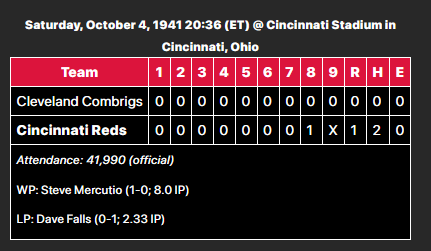
In perhaps one of the most captivating performances in recent memory, Steve Mercutio of the Reds pitched a no-hitter, freezing out the Combrigs in a devastating 1-0 game. The only score of the game came on an RBI double late in the 8th inning, securing for the Reds the victory, and giving them a glimmer of hope in mounting a comeback against the Combrigs.
With this victory, the Combrigs lead in the series shrank to 3-1.
**Game 5

The final game of the series was tightly contested across the board, with each time scoring a single run in each inning through the fourth inning. With the game tied 4-4 going into the bottom of the 9th, Jack Hammerhead who had been forced to come off short rest due to bullpen injuries, and had been performing well since the middle of the 7th inning, pitched a ball that was driven deep into centerfield by the Combrigs, setting up for the walk-off run, ending the game and Cincinnati’s World Series hopes.
With this game, the Combrigs won the 1941 World Series, 4 games to 1.
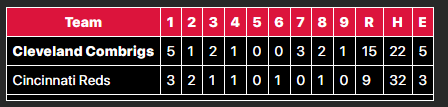
**Composite Score
Looking Forward to Future Seasons
The 1941 season, and subsequent issues managed by the Major League office created some interesting rule changes for subsequent seasons.
Beginning with the 1942 season, three rules would be implemented or changed to fit the ever-changing reality of baseball. The first thing was that after years of gender and sex discrimination, Major League Baseball finally lifted a pre-revolution rule forbidding female players from participating in the league. The following season saw the first female player signed to a major club, Jackie Mitchell (SP) was first signed by the Chicago Spartacists for the 1942 season. She would be not only the first woman to play in Major League Baseball, but also the first woman to win a World Series (1944) and later the first female manager (1958). She would play for the Spartacists and Giants before her retirement from the league in 1953.
Second, as part of an effort to speed up play during extra innings, the MLB experimented with a rule that would mandate that at the start of every half-inning after the bottom of the ninth (seventh in doubleheader games), the team at-bat would begin with a runner at second base. Normal rules would then apply. Initial response to this rule-change was mixed, giving rise to the term Pershingball or Morty Mouse Extras which has persisted to this very day, often used as an epithet by fans of losing teams.
Thirdly, the lengthy distinction between the AL and NL, the presence of pitchers or designated hitters on the roster, was decided in the AL’s favor. Starting in the 1942 season, the ‘universal DH’ rule was implemented, bringing both leagues into alignment on specific player roles.
Additionally, throughout the remainder of the war, two other teams would change their logos and names to appeal to nationalist sentiment and revolutionary fervor in the war against Germany and their fascist allies. In anticipation of the 1943 season, the Chicago White Sox collectively rebranded themselves to the Chicago Spartacists , while in 1946, the Detroit Tigers would take the name Tankers , in recognition of the role that Detroit’s various automotive and mechanical collectives served in creating the tanks that were instrumental in the course of the war.
The growth of the league following the Great Revolutionary War would lead to some franchises being relocated to the West Coast, following the footsteps of the San Francisco Giants— and would subsequently support a number of expansion franchises, leading to teams being raised from cities like Tampa, Denver, Phoenix, Seattle, among others.
**Teams of Major League Baseball after the 1941 season
American League**
- Boston Red Sox
- Chicago White Sox
- Cleveland Combrigs
- Detroit Tigers
- Metropolis Yankees
- Philadelphia Athletics
- St. Louis Browns
- Debs Defenders
National League
- UMC Green Bay Packers
- St. Louis Cardinals
- San Francisco Giants
- Chicago Cubs
- Boston Bees
- Pittsburgh Pirates
- Brooklyn Dodgers
- Philadelphia Phillies
- Cincinnati Reds
*[WPA]: Works Progress Administration *[NBI]: National Bureau of Investigation
Bình luận
0