[Done with some vital help from @vilani99 . Thank you, vilani! ]
Excerpts from Adrien Guerland,Edges of Darkness: The Rise and Fall of The French State (Paris: Fraternité, 2012)*
Edges of Darkness is a 2012 popular history book written by Adrien Guerland, detailing the rise of the French State, from the beginning of French right-wing movements and organizations and their role in it, to the atrocities committed by the National Collectivist regime, until its eventual capitulation to Franco-British forces. It was one of the many non-academic historical works to be written after the exposes of the French State’s role in the Holocaust, and is a polarizing book in the Franco-British Union, in contrast to a unanimously positive reception in the ComIntern.
Clouds on the Horizon
The Second American Civil War was, by every means, one of the many events that had an impact on every corner of the world in some way or the other. In France, this impact would manifest itself in the emergence of a new ideological strain of right-wing politics in the French political scene in the 1930’s, as well as two new political parties that adhered to it.
……..
After the Red May Revolution, the Third Republic experienced a Red Scare like never before. The shock produced by the fact that the nation which so far had been considered to be the beating heart of capitalism had succumbed to a communist revolution, had started to take root amidst the populace, leading to some uncomfortable questions being asked. If it could happen to them, it was argued, then there was no reason why it wouldn’t happen in France, considering the history of the French Revolution and the Paris Commune.
The opposition to the ideals of the Revolution and the Commune, coupled with a nostalgia for the monarchy and a significant spike in anti-Semitism after the Dreyfus Affair was what led to the formation of the Action Française , a counter-revolutionary, anti-parliamentary movement that would stay at the fringes of the extreme far-right. They would be at the peak of their influence during the next twenty years after their formation in 1899.
Although the victory against the Deutsches Kaiserreich in the Great War led to an upsurge of jingoistic fervor, and the Russian Revolution had led to a fear of Bolshevism, the AF were not well placed to exploit the situation. The rise of fascism as a political ideology, especially in Germany and Italy, presented a threat to the regressive supporters of the House of Bourbon. Matters would be complicated further by Pope Pius XI condemning the Action Française on 29 December 1926; followed by many of Maurras’ writings being placed on the Index Librorum Prohibitorum on 9 January 1927. This was in no small part due to Maurras’ utilitarian approach towards Catholicism, which unsettled most of those who agreed with him on many issues. On 8 March, AF members were forbidden to receive the sacraments, thus rubbing salt in the movement’s wounds and subjecting its cadres to social ostracism. This, along with the failure to gain any significant level of popular support in the face of the Fédération Républicaine , would prompt many to leave. Noteworthy among them was Eugène Deloncle, the founder of the notorious terrorist group, La Cagoule.
……..
As the first half of 1933 saw the success of the Second American Revolution, leading to the aforementioned Red Scare, the AF felt that they had a chance to rise out of the ashes. But unbeknownst to Maurras and the rest of the AF leadership, the seeds of a new right-wing movement had been sown the previous year. One that would eventually supersede and consolidate most of the disparate movements and organizations on the right in due time.
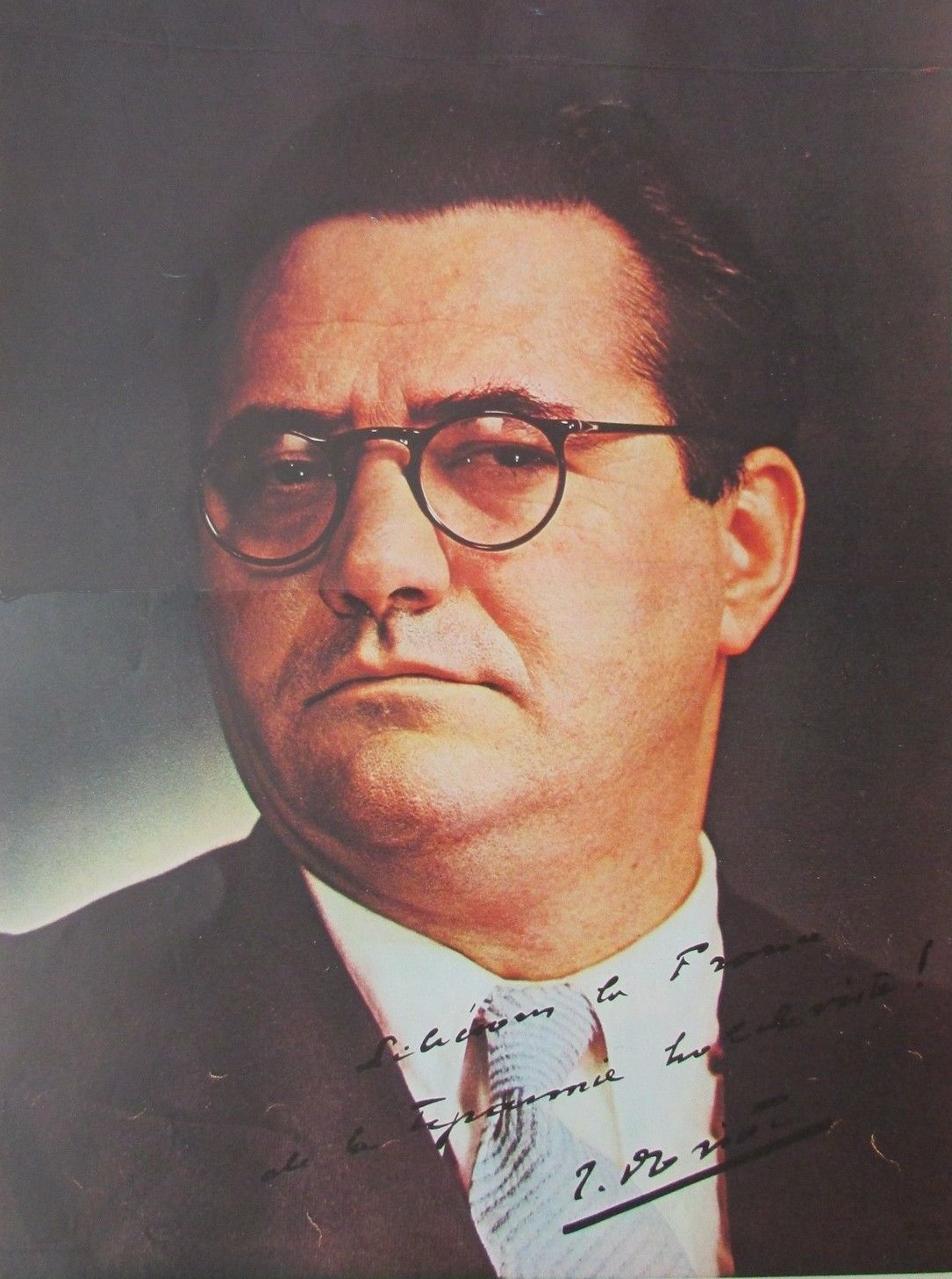
In 1931, Jacques Doriot, the SFIC mayor of Saint Denis proposed that the ComIntern follow a “Popular Front” strategy of alliance between the Communists and other Socialist parties in order to contain the rising threat of fascism and prevent it from taking root wherever possible. While the Popular Front would indeed become official ComIntern policy later on and yield results, at the time he suggested it, there was still a year to go before the 1932 American presidential elections, the most prominent and successful example of this strategy, and the staunchly Stalinist SFIC would not countenance such an alliance with the “enablers of bourgeois capitalism”. The Politburo quickly got wind of the matter and acted with alacrity, expelling him from the party in 1932 (1).
Disillusioned and infuriated at his expulsion, Doriot made a vow to himself that, from that moment onwards, he would work for the destruction of Communism however he could. His political views took a sharp turn towards the right, culminating in him founding the Parti Populaire Français in 1933 (1), widely considered to be the first fascist party in France. The PPF adopted a platform of nationalism, corporatism, class collaboration, anti-communism, anti-Semitism (after 1934), anti-capitalism, anti-liberalism and a vicious opposition to Freemasonry. It also declared in its manifesto that “France must look to the past to seek strength and inspiration, not to recreate it, as some deluded people would rather prefer to”. This could only be interpreted as a slight directed at the Action Française , and dictated the state of relations between the two movements, with Doriot and Maurras regularly attacking the other in their party newspapers.
……..

In 1934, Pierre Clémenti, a young Corsican who was then a sports columnist for the press of the Radical-Socialist Party, took the decision to leave the party. Having already cut his teeth in the circles of militant French nationalism (in 1932, he was on the leadership board of the National League of French Youth, and in 1933, he helped Henry Coston in forming the Francistes party, as a splinter of the Mouvement Franciste), he no longer fit in with the center-left policies of the Radicals.
After an acrimonious fight with Coston, Clémenti would leave the movement, taking the bulk of the cadres with him and forming the Parti Français National-Collectiviste. The PFNC had a platform that was practically similar to the PPF; however, there were a few differences. Firstly, they believed in a theory of racial supremacy not dissimilar to the NSDAP’s idea of Herrenvolk. Secondly, they were more nationalistic than the PPF, calling for the partition of Belgium on ethnic lines and the formation of la plus grande France (Greater France). Indeed, in 1934 itself, Clémenti had contacts in the right-wing of the Walloon Movement. This would put them on a collision course with the Belgian Rexist Party and its charismatic leader, Léon Degrelle. Like the PPF before them, they were also contemptuous of nostalgia for the French Empire, antagonizing the Action Française and inviting vitriolic attacks from them in the process.
The PFNC was, from its early days, funded by the Third Reich; indeed, Clémenti had befriended the chief propagandist of the NSDAP, Julius Streicher, after quite a few guest appearances at their rallies. On the other hand, the PPF had to compete for Italian funding with the Mouvement Franciste at first, but as time went by, Mussolini was convinced by his closest advisors that Doriot was the better bet over Bucard, leading to the Francists having their funds cut and diverted to the PPF, something that would cause bad blood to develop between Doriot and Bucard for a while.
……..
The 1936 legislative elections were marked by two major events: one, the SFIC, the SFIO, the PRRRS and various other Socialist parties fought the elections under the banner of the Popular Front, using the very strategy that Doriot had suggested back in 1931. The irony of it was not lost on the SFIC and Doriot, who would launch quite a few barbs at his former party during the campaign. Secondly, the PPF and the PFNC, participating in national level elections for the first time, were able to punch significantly above their weight for two new parties, with the former getting 54 deputies and the latter getting 30. A scrutiny of the results shows that the PPF and the PFNC had usurped the lion’s share of the voter base of the FR and the PRAS (Parti républicain agraire et social), by effectively playing on the fears of the conservative and rightist sections of the French populace and at the same time, employed a populist rhetoric designed to attract the French working class, something that was new to the political scenario of the Third Republic. More than that, it marked the beginning of the decline of the Center as a viable political force in France, as the Left began to coalesce and come together, mirrored by similar developments on the Right.
As the newly elected Front Populaire government and the rightist opposition settled down to business, Doriot and Clémenti found themselves coordinating the actions of their parties in the Chambre des députés, with the PPF deputies supporting their PFNC counterparts in any debate, and vice versa. Joint marches were undertaken by both parties, seeking to drum up support for the Nationalists in the Spanish Civil War. Indeed, this was mostly possible due to the strong ideological similarity both parties had, in addition to the cordial, friendly relationship between their respective founders (2). In December 1936, Clémenti suggested that their parties be merged, considering that their views and goals were practically the same, and that it would be better to stand united and work towards achieving them. Doriot replied that he would bring it up at the next Congress of his party.
Half a year later, in June 1937, the two of them declared the formation of the Parti Populaire National Collectiviste Français (French National Collectivist People’s Party, PPNCF), the party that would not only go on to become the dominant face of fascism in France, but also the primary driving force of the regime that would join the Pact of Steel.
……..
By 1939, after the successful annexations of La Rocque’s Parti Social Français and Bucard’s Mouvement Franciste , the PPNCF stood tall like a Colossus in the French political stage. Very few noteworthy right-wing movements existed from that point onwards, with the exception of Déat’s Rassemblement National Populaire , a grouping of Neosocialists who had been expelled from the SFIO for adopting a National Syndicalist stance, and the Action Française , which by this time, was eking out a miserable existence, sustained only by Maurras’ painstaking efforts. The atmosphere in France was tense, with Germany having annexed Czechoslovakia the year before. The PRRRS and Daladier had, in all honesty, made an attempt to stand up to Berlin, even withstanding British pressure on the matter. But the Radicals’ hand would be forced by the military and the government’s center-right and right-wing allies in the Chambre , with Daladier forced to renege on agreements with the Czech. It was a bitter humiliation for him, and as Germany invaded Poland later in 1939, he would belatedly realize the poison chalice that was the offer of support provided by Doriot and Clémenti last year. Indeed, the decision to shake hands with the PPNCF had not gone down well with many in the party, as well as its voter base. This would have significant consequences in the legislative elections next year.
Darkening Skies
If the 1936 elections were a testimony to the extent of the divisions in French society and politics, the 1940 elections served to showcase the level to which the French populace had been polarized. With the first Popular Front government leading to significant activity on the part of the right, and a shameful foreign policy disaster of the succeeding Radical government leading to the left becoming increasingly bellicose, one could easily say that two Frances existed in the Métropole.
Due to the PRRRS’s backroom deal with the PPNCF and the humiliation suffered to Germany, its voter base would abandon them en masse and shift to the left, boosting the numbers of the SFIO and the SFIC. On the other hand, the PPNCF benefitted largely from the lack of any notable challengers on the right, and thus was able to nearly triple their numbers in the Chamber of Deputies, reaching a total of 234 deputies. The elections threw up another surprise: the RNP entered the Chamber with 22 deputies. Observing the writing on the wall, Déat would quickly form a post-poll alliance with Doriot, Clémenti and Bucard - the Front de la Liberté (3) (Front of Liberty). The Popular Front had returned to power yet again, but the path in front of them was more difficult than ever.
The Stahlpakt would invade the Soviet Union barely five days after the election results came out, giving the newly elected government its first major challenge as the PPNCF paramilitaries, the Blueshirts and the Gardes Française began to march regularly through the streets of several cities as a show of force, chanting pro-German, pro-Italian, anti-Soviet and anti-American slogans, which provoked an inevitable response from the SFIC’s own paramilitary cadres, leading to bloody clashes and brawls across the country. The PF government condemned the streetfights, though not before having to deal with an exceedingly acrimonious shouting match in the Palais Bourbon over the very same issue. Considering the numbers of the Front of Liberty, such incidents would recur rather often in the future, especially when the government made attempts to discuss the “relations of France with her eastern neighbours”.
The Axis invasion of Norway on 10 October, 1941 would spur Blum and his government into action. A few days ago, he had sent Jean Monnet to London, intrigued by his idea of a “Union” with Britain in the event of war. Roughly ten days after Norway was attacked, France would sign a nonaggression pact with Liberia. The last action had led to some consternation in military circles, with the overall opinion being that it sent a negative message to Berlin and Rome. On 12 December, a general order of mobilization would be promulgated, in response to increased German presence in the Rhineland and the “inevitable breakout of hostilities with Germany”. It would begin the chain of events that ended with the fall of the Popular Front and the Third Republic, the formation of the French State, and the United Kingdom declaring war on the Anti-ComIntern Axis.
……..
The order of mobilization only inflamed an already volatile domestic situation in the Métropole. While left-sympathetic citizens queued up at recruitment offices and centers, their rightist brethren arranged for elaborate and aggressive draft-dodging campaigns. Attempts to dissuade and intimidate potential military recruits often turned violent. The Cagoulards took to bombing recruitment offices, adding to the workload of the already exhausted police and Gendarmerie.
On December 15, Doriot, Clémenti and Bucard denounced the mobilization order in an energetic speech:
“People of France! The dupes and puppets who are governing our beloved nation would have you believe that by raising your arms against our eastern neighbours, you are fighting for the honour of France. Nothing could be further from the truth! In reality, you are being lied to, to fight a war for the Judeo-Bolshevik puppet masters in Russia and America, for their false, mongrelizing creed of class struggle and internationalism! They seek to destroy all we hold precious: our national identity, our unity, our society and our religion! We call upon you to resist this “call to arms” that will spell doom for France! Vive la France! ”
The resulting riots would occupy the government’s attention for some time, and in the meantime a malevolent plot was underfoot in the military; one that had been kick-started by the mobilization.
The French Army had a tradition of deep rooted conservatism, as was typical of most European militaries in the interwar period. However, it was not merely political , but also doctrinal - as can be attested to by the fact that the French military was modernizing at a highly lethargic pace, and by the early 1940’s, was appreciably inferior in several regards to the Wehrmacht and the Italian military. The expectation of the generals after 1933 was that they would be fighting off a Soviet-American invasion of Europe - a strategic calculus in which Germany and Italy would be co-belligerents, if not allies. It was no surprise then that the order to mobilize was received poorly by the High Command.
For most of the generalship, already displeased with the Front Populaire for being “too soft on the Bolsheviks and the Maximalists”, this was the last straw. Many of them would coalesce around Maréchal Philippe Pétain, the Marshal of France and the Lion of Verdun, and begin to weave the threads of the conspiracy that would “save France from falling into the dark abyss of Communism”. The Old Marshal began by reaching out to as many generals and commanders as he could, while at the same time sending out feelers to the leaders of the PPNCF, the RNP and the AF. Telegrams were sent to the German and Italian embassies in Paris, informing them of the developments. The missives that Cécil von Renthe-Fink and Giacomo Acerbo would send to Berlin and Rome afterwards, would please the Führer and the Duce to no end. Germany and Italy had been looking for a way to get Türkiye into the war on their side since the Izmir Conference, and this opportunity could not have come at a better time; not to mention the possibility of bringing one of the foremost continental powers into the war in the east, thus killing two birds with one stone.
For the rest of December and much of January, levels of violence across the country would fall considerably, as the right-wing paramilitaries began to preserve their strength for what was to come. Even the excessively violent Cagoulards seemed to have gone quiet. An uneasy calm descended upon the Métropole - it was but the harbinger of the storm to come.
The Deluge Arrives
The dominoes would start to fall from 28 January, 1942, when Blum declared war on Germany. Just five days later, on 2 February, Pétain delivered his pronunciamiento , declaring the military’s loss of faith in the civilian government. The leaders of the coup d’état gave an address to the “loyal patriots of France” to “arise, and take back the country from the clutches of the communist puppets in the Palais Bourbon ”. Statements of support for the Maréchal came in from the commanders of the troops stationed in Alsace-Lorraine and Provence, precipitating a tense standoff between the government and the military.
In London, the Conservative government of Edward Wood took a highly controversial and, according to his many critics, spineless stance regarding the developments in France. By declaring that “His Majesty’s Government will take no action whatsoever on behalf of the government of France other than acting as a mediator for peace negotiations” between the civilian government and the rogue military high command, Prime Minister Wood had performed the ultimate act of appeasement, with the blessings and support of King Edward VIII. The outrage triggered by the declaration would culminate in half the Conservative delegation in the House of Commons crossing the aisle the next day, making a no-confidence vote all but inevitable. Feeling disgraced by the outcome, Edward abdicated that very day, in favor of his brother, George VI.
The standoff ended when the Corps de Cavalerie , under the command of Général René Prioux, marched on Paris. He hoped to seize the capital quickly with his three light mechanized divisions, and overthrow the government before a civil war broke out between the Pétainists and the Loyalists. Whether Prioux acted on his own, or on the orders of his army group commander, or on the personal orders of the Lion of Verdun is difficult to ascertain, as many of his fellow generals and co-conspirators, as well as his staff and subordinate officers, either did not survive the war or refused to divulge what they were aware of, eventually taking the secret to their graves. Additionally, a large amount of the documentation regarding the actions of the PPNCF regime was destroyed in the twilight years of the war, leaving us with little to work with.
Regardless of whose orders Général Prioux acted on, it is certain that the French Civil War began with Prioux’s advance on Paris. Parisian citizens took to the barricades to block the advance of the Corps de Cavalerie. The Gendarmerie , along with the help of Communist paramilitaries, fought tenaciously enough to give the mobilized reserve divisions loyal to the Republic time to reinforce the capital. However, they would be stymied by the vicious, bloody fighting on the part of the Blueshirts and the Gardes Française , who made desperate efforts to break up the barricades.
The events of 10 February are enough to put an end to all excuseology and apologism for France’s heroes of the First World War. That evening, Pétain, accompanied by Doriot, Clémenti and Bucard, met with Rudolf Hess, Hitler’s favored lieutenant, and Count Galeazzo Ciano, Mussolini’s foreign minister. They brokered an agreement in which Germany and Italy would support and recognize a new regime under Pétain’s leadership and assist with the pacification of the country. In exchange, the French State would become a signatory of the Pact of Steel, join the Anti-ComIntern Axis, and enter the war in the Soviet Union.
On the next day, the German and Italian governments announced a police action in support of “the French people’s valiant efforts to throw off the Judeo-Bolshevik yoke.” The 1st and 2nd Army Groups, constituting the bulk of the French Army’s modern mechanized forces and combat power turned towards the heartland, supported by the German Army Group West. Italian marines and paratroopers landed on Corsica, quickly overwhelming the meager opposition they encountered.
The Darkest Hour
The Pétainist forces stationed in Alsace-Lorraine made relatively good progress, only slowed down by the valiant efforts of Loyalist officers and soldiers, who put up a desperate, if unorganized defense, hoping to buy as much as time as possible for the FP government. But with the troops of Army Group West pouring in, this would prove to be nothing less than a Herculean endeavor. Still, the Loyalists made sure to hold ground at all costs, as the cry of “Ils ne passeront pas!” rang out and the blood of Frenchmen stained Northeastern France yet again.
In spite of their heroic, Thermopylaean sacrifices, they could only hope to delay the inevitable, as Calais would fall to the Pétainists after the local Gendarmerie were overwhelmed by the Blueshirts and the Garde Française , who managed to hold on to the city for long enough to be relieved by a motorized infantry division. In Provence, however, the Pétainists found themselves in a difficult situation as they were outnumbered by the Loyalists, and after a series of bloody skirmishes, they would be forced to retreat to Nice and Marseille. They prepared themselves for a siege, as the Loyalists made several offensive attempts against the two cities. The standoff would be broken only by the mutiny of the Flotte méditerranéenne. As the warships stationed in ports across southern France declared support for the Pétainists, the morale of the Loyalists shattered like glass, as they were forced off the eastern half of the southern coast. More army units defected, and by the beginning of March, Provence would be firmly in Pétainist hands.
On the heels of the loss of Provence came further disaster, as the units of the Corps de Cavalerie entered Paris on 4 March, to a joyous welcome by right-wing paramilitaries and citizens. The government was forced to retreat westwards, to Loire and eventually, Brittany. All Loyalist military units were ordered to preserve their strength and retreat. But in the midst of the chaos that engulfed the Métropole , with the morale situation being rather critical, it was effectively every man for himself. In spite of this, the Loyalists of the First Army would attempt to march westwards to Brittany, and their fellows in the Third Army would march south through the Pyrenees to the Spanish Free Soviet Republic, in what is now known as the Marche du chagrin (March of Sorrow).
Throughout April, the retreating Loyalists were harassed by Pétainist units of the Armée de l’Air , who had made their choice to defect once it became clear who was going to triumph. With turncoat forces on their heels, the fear of air raids, abysmally low morale and an undercurrent of suspicion among their ranks, the First Army’s Loyalists somehow managed to reach Brittany, a broken and demoralized lot who were desperate for succor. With the help of the RAF and the Royal Navy, they would be evacuated to the Home Islands in one of the largest evacuations in military history - Operation Dynamo.
For the Loyalists of the Third Army, the march to Red Spain was nothing less than a march through hell, what with the defection of the Mediterranean Fleet forcing them to avoid the southern coast at all costs. This left the Third Army with two options: brave the interior passes of the Pyrenees, or make for the Atlantic coastal passage and risk falling into the jaws of the Pétainists. As the putschists traversed the Massif Centrale , a decision was made: they would make for the Pas de la Casa and the Col de Puymorens. A spirited rearguard action on the part of the 6th Corps bought the remaining two corps enough time to make it to their designated passes, forcing the Pétainists to cease their pursuit. In Paris, Pétain and his allies could do nothing but accept the escape of the Third Army as a fait accompli and focus on consolidating their new regime. It was just as well that the turncoats stopped their chase, considering the terrifying conditions in Southwestern France at that time of the year. Temperatures in April in the Col de Puymorens average at -0.5°C at the lowest, and the Pas de la Casa at -1.4°C, and April 1942 was a cold month. Fortunately for the Loyalists, the Pyrenees were a relatively short crossing, with the first exhausted soldiers arriving at the railhead in Sort on the other side just two weeks after the evacuation order was given. A week after that, on the 15th of April, the last remains of the 6th Corps arrived in Red Spain.
The Loyalists in the Spanish FSR had a feeling that they didn’t have much time on their hands. By crossing the Pyrenees, they might have evaded the putschists for the time being, but it was only a matter of time before the Spanish State would be persuaded to “complete its unfinished business”. Their concerns were shared by many in the Admiralty and the Imperial General Staff, who began to prepare for another evacuation after Dynamo. They would have at least a month in their hands before the Falangists would eventually pounce on Red Spain and, more worryingly, were racing against time, as on 4 April, Hitler had started pressuring Mussolini and Mola to declare war on the Franco-British Union.
1.IOTL, he was expelled in 1934 and formed his party in 1936.
2.A 180° swing going on here - IOTL Clémenti was deeply hostile towards Doriot, considering him still to be a communist, even after he was expelled from the SFIC/PCF.
3.An alliance that Doriot was trying to push with the PSF IOTL, which was rejected by La Rocque due to apprehensions that it was an attempt to annex his party. *[WPA]: Works Progress Administration *[NBI]: National Bureau of Investigation
Bình luận
0