100% Americanism: The United States Stirs from its Bryanist Slumber
“And so all pretenses are dropped and capital sheds its mask of humanity.”
-Eugene Debs, 1920
The Bolshevikis have come to town,
With a Russian cap and a German gown,
among the workers they’re sure to be found,
for they’ve come to destroy AMERICA.
They sit in judgment on capital hill,
and watch Mr. Wilson’s patriotic bill,
and without their O.K, it passes-NIL.
For they’ve come to destroy AMERICA.
They will use the movie and lyceum too,
to incite simple blacks and crafty jews,
they prate propaganda from pulpit and pew,
For they’ve come to destroy AMERICA.
They have a quite sinister plan,
To use the bomb and the firebrand,
and incite class hatred wherever they can,
while they’re busy destroying AMERICA.
The special stunt is to arouse the mob.
To expropriate and hate and kill and rob,
While they’re working on their political job,
AWAKE! AROUSE!! AMERICA!!!
-“Awake America”, Lucia Maxwell
This is called talkin’ All-American blues
And there’s nothing wrong with this song
Well, I was feelin’ sad and kinda blue
I didn’t know what I was gonna do
The communists was all around
They was in the air
They was on the ground
They was all over
So I run down most hurriedly
And joined the All-American society
I got me a trusty membership card
I went back home to the yard
Started looking on the sidewalk
Under the hedges
Well, I got up in the morning I looked under my bed
I was lookin’ every place for them crazy reds
Looked behind the sink, and under the floor
Looked in the glove compartment of my car
Couldn’t find any!
Look behind the cloths, behind the chair
Lookin’ for them Reds everywhere
I looked way up my chimney hole
Even looked deep inside my toilet bowl
They got away!
I visited the local library
and found a book by a Mr. Nietzsche
Now he had a mustache that looked German
So I went to visit my friend Herman
And learned Nietzsche was a good American!
One of the good ones!
-“Talkin’ All-American Blues”, Bob Dylan
**Excerpts from the book “Embattled Republic: The Transformation of the American Polity, 1914-1945”, by Richard Hofstadter
Published by Alfred A. Knopf © 1958, New York City, United States**
On the eve of William Jennings Bryan assassination, American society was already divided into two polarized political camps. On the one side were the Bryanist stalwarts: the small farmers of the midwest and great plains, industrial laborers, middle-class suffragists, pacifists, and isolationists, and Irish, German and Italian immigrant communities. On the other was the burgeoning opposition: this included not merely the old “eastern establishment” of financiers and industrialists, but also the majority of the urban middle-class, white-collar workers, and an increasing share of the traditionally anglophilic southern elite. Increasingly, each political camp suspected the other of a “great conspiracy”. For the Bryanists, this was the plot of the wealthy and connected to suppress the legitimate democratic and economic claims of the working man; in their collective political mythology, the only figure who truly had the chance to frustrate the dastardly plot of the financiers was Bryan himself, who inspired a nearly religious level of devotion among his closest followers. Opposed to Bryan’s charismatic authority was the more formally institutionalized power of America’s traditional elites. These aligned almost uniformly with the opposition, and controlled all the nation’s leading organs of news. Over the second Bryan term, they launched a seemingly unending propaganda offensive against the president. Soon, a very different conspiracy emerged: Bryan was, the story went, a secret bolshevik, preparing to hand over the keys of the nation to Vladimir Lenin and the unamerican, uneducated mob of hyphenated-americans. The “plot to destroy America” was detailed in every major newspaper, and spider charts were published linking Bryan and his union supporters to the “communist menace”.
In short order, each camp received confirmation of their anxieties. Bryan’s assassination and the dubious ascent of Wilson was met with great outpourings of grief and rage across the great plains and thousands of working class neighborhoods. To a crowd of several hundred thousand Chicagoans, Eugene Debs eulogized his erstwhile political ally: “The man and I have had our share of differences, and yet I cannot fail to feel a deep admiration for this most ardent champion of the working man, who found his way to the doctrine of socialism through little else than his own sense of moral conviction.” Robert la Folette warned of a coming crusade to “demolish the great edifice that Bryan has built”, while Lynn Frazier, the non-partisan governor of North Dakota, darkly hinted at a “coming conspiracy to wreck the working man.” There could be no doubt of the “plot against the American worker” now.
The New York Times and Chicago Tribune duly condemned the outbreak of political violence, even while cheering the dubious ascent of Woodrow Wilson. Unsurprisingly, the presidency of the southern professor was shadowed by a pall of illegitimacy. This was not helped by persistent rumors of his poor health and clandestine connections with Britain. In a monumental political blunder, Wilson succeeded in enraging the Bryanist opposition by mentioning the need to institute a draft during one of his first few press conferences. Protests and strikes immediately emerged in response, and it quickly became clear that congress was not willing to provide Wilson with such an authorization until there was a more clear direction to the draft itself. Yet the continuation of isolated industrial actions contributed to the anxieties of the conservative camp, who speculated about an “internal bolshevik opposition” which Bryan had successfully planted during his presidency.
Initially, Wilson’s own health seemed to stir nearly as much concern among the reactionary elements of the American polity as the looming Bolshevik threat. Congress engaged in a concerted campaign to convince Wilson to voluntarily step down and give the presidency to a younger and more able figure. This was met by continual stonewalling from the administration. Wilson retained some support amongst the southern democrats, but the Republican congress at once began investigating the President.
…No event did more to confirm the most paranoid fears of the American business class than the general strikes that ripped across New York, the industrial midwest, and the pacific northwest in November. The fact that this wave of industrial action occurred simultaneously with the strikes that brought down the governments of France, Germany, Bulgaria, and Austria seemed to incontrovertibly prove the presence of a Bolshevik conspiracy. Such quickly became the political line of not just the nation’s leading newspapers, but also of Wilson’s government.
Woodrow Wilson, who served the second-shortest Presidential term in American history
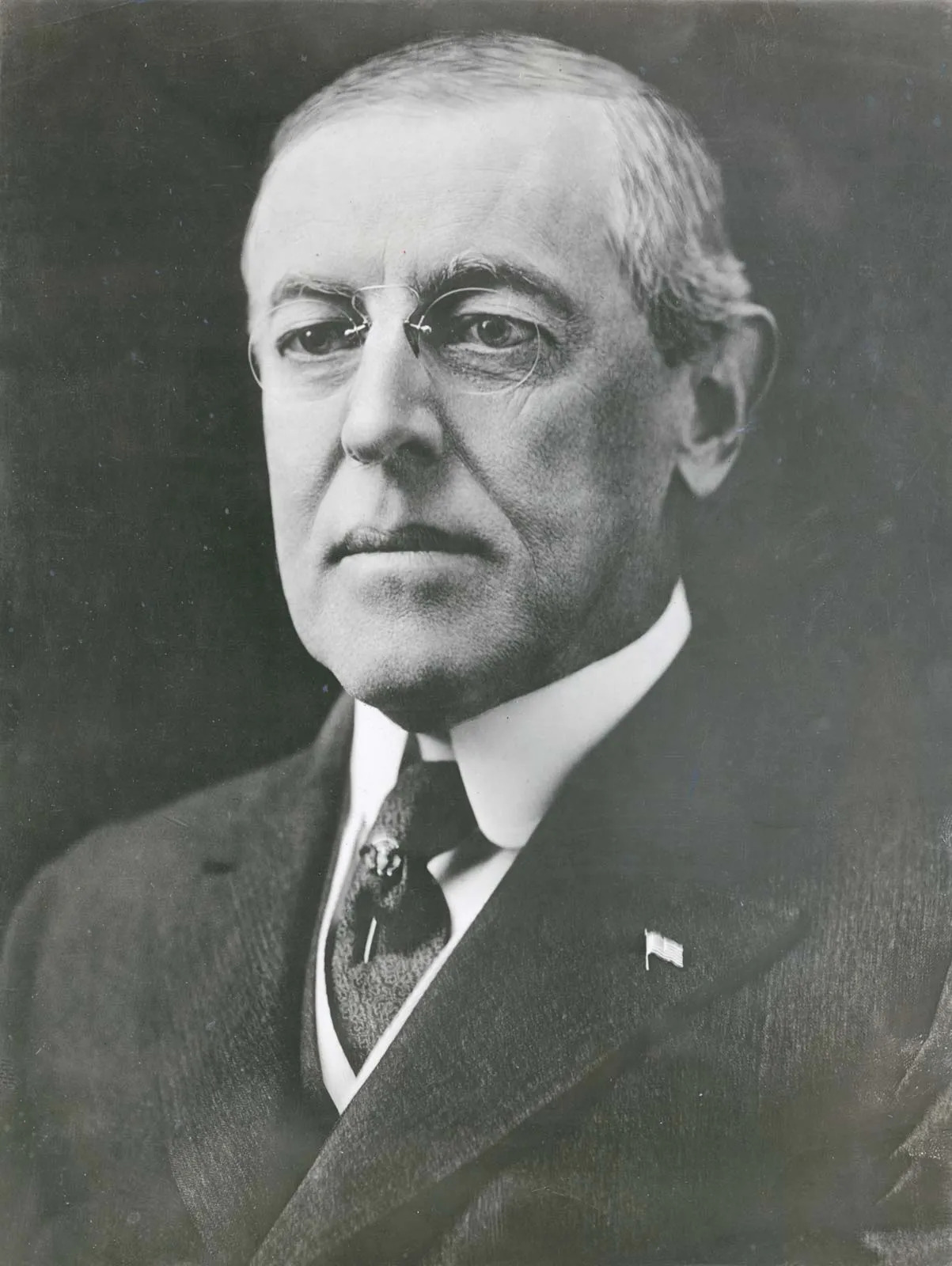
The vast powers of mobilization that the business community had steadily cultivated for the past half-decade were at once put to use. It was felt, first and foremost, that the current president would have to be replaced by a more dynamic and compliant figure. Southern congressmen attempted to resist the tide, but it was of little use: news leaked that Wilson had suffered a stroke shortly after the strikes began, and panic spread across D.C. of a “rudderless presidency”. On November 12th, Wilson chose to resign rather than face impeachment. So began the month of three presidents. The new president, Bryan’s Secretary of State William Borah, was still plagued by his involvement in the Indian affair. Shortly before Wilson’s resignation, he had come to a private agreement to step down from office after the Senate determined a proper candidate for the next Secretary of State (and hence President). In return, he would receive a pardon. A sense of patriotism (and, one has to judge, a desire to receive a pardon) obliged him to accept his role as “caretaker president”, but he impressed on his colleagues the urgent need to find a replacement. And so, the Senate, now controlled by conservative republicans and their dixiecrat allies, began to look for a suitable “Secretary of State”; technically, they would have to be nominated by Borah himself.
The Republican Party was torn on whether it was best to elect a unifying national figure such as Leonard Wood or John Pershing, or instead press forward with a more partisan ultraconservative whose first priority would be to rollback the progressive legislation of the Bryan era. All believed that a strong and dynamic figure was necessary, prompting some to float the name of the two-time loser Theodore Roosevelt, but it quickly became clear that the emboldened business wing would not tolerate a progressive. Yet a number of politicians and industrial elites proved equally apprehensive about several doctrinaire, free market conservative candidates; they worried that the likes of Henry Cabot Lodge, Warren Harding, and Frank Lowden lacked the spine, charisma, and “sense of mission” necessary to take on American bolshevism. The traditional doctrine of limited government was felt to be manifestly inadequate to the moment.
In the end, it was a dark horse candidate, Elihu Root, who won the support of the Senate. Root had served a single term as a Senator from New York, and before that, had been both a Secretary of State and Secretary of War in the Mckinley and Roosevelt administrations. His impeccable foreign policy credentials and ultraconservative politics were felt to fit the present moment, though he was instructed to remain quiet about his rather unpopular opposition to female suffrage.
Elihu Root, the 31st President of the United States
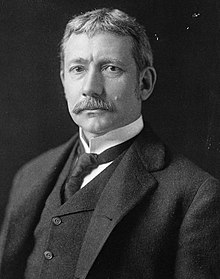
Ironically, Root was ten years older than Wilson, and it took a great deal of convincing to conscript him into the Presidency. He put forward several recommendations of his own for the position, which were all felt to be unsatisfactory. Eventually, he acquiesced, on the condition that he would resign the presidency once “the present crisis was brought to a close”. Whatever one’s judgment of Root’s politics, there is little doubt that the man was one of the most brilliant administrators in American history. Over the four years in which he remained in office, he transformed the American polity beyond recognition, creating a network of new bureaus and institutions that have been collectively termed the “security state.” For his opponents, he was a diabolical genius who wielded the extensive powers of the presidency to turn America into something less than a democracy. “Under the present banner of anti-communism”, remarked H.L. Mencken some years later, “We have constructed a vast and imposing edifice which mirrors in its precise details the most despotic elements of Bolshevism.”
Building The Anticommunist State
When Root ascended to the presidency, industrial unrest still raged on, and the financial crisis had only inflamed the protests roiling the midwest. Joe Lewis’ superbly organized CIU had swelled with new recruits; over the past two years, it successfully assimilated several more conservative unions, and in late 1918, facing declining membership, even the radical IWW chose to affiliate with it. Contrary to the perceptions of the American elite, Lewis was not an ideological socialist, but he intended to use the present crisis to solidify the place of labor and make the CIU a permanent fixture of the industrial landscape. Standing behind him were countless still un-unionized workers who had joined his strike in solidarity, making it the first truly national general strike in American history.
Upon entering office, Root enacted a sweeping legislative package redefining the relationship between government and civil society. The “Constitutional Protection Act” made it a crime to use “disloyal, profane, scurrilous, abusive language” about the United states government, its flag, the armed forces, and its system of constitutional government, or to engage in “protest, organization, or assembly” that can be “reasonably interpreted to be opposed to the American system of private enterprise and constitutional order”. The act also prohibited all language and activities which were intended to, or in effect led others to have “contempt for the American government, its constitutional order, and its institutions.” A single day after it was signed, the entire leadership of the CIU was declared to be in violation of its provisions. A stream of arrest warrants followed; the leadership of the non-partisan league and Socialist Party of America were soon also placed under arrest. The American military was deputized to quell the subsequent (and ongoing) labor unrest.
Next came the “Industrial Relations Act”, the most important piece of legislation in the employers counteroffensive. All of the labor reforms of the Bryan era were summarily voided, and in its place came a new, highly draconian structure which required all industrial unions to seek “pre-clearance” with new government “labor deputies” before forming new locals. All unions would be forced to submit monthly reports detailing their efforts to “eliminate unamerican radicals”; the presence of activists who violated the Constitutional Protection Act in even the middle ranks of unions could be used as grounds for dissolution. The state would retain the right, until the end of the present emergency, to engage in warrantless searches of union offices who were suspected of disloyalty. This legislation succeeded in cowing the craft unions into slavish obedience.
Perhaps the most infamous legislation, however, came in early 1920. For the purpose of enforcing the previous legislation, in consultation with Root, Congress passed the National Security and Protection act, which created the National Bureau of Investigation and Intelligence (NBII) as an agency within the Justice department. Begrudgingly, military and naval intelligence were forced to subordinate themselves to the gigantic new agency. The anticommunist former mayor of seattle Ole Hanson was placed at its chief. The bureau was mandated with coordinating all intelligence gathering and serving as a general antisubversive body. With the assistance of the tireless deputy director Edgar Hoover, the body began acquiring a great deal of power, prompting the president to deputize the middle-class “All-American leagues” and conscript them into the structure: it was hoped that these groups, controlled by the business community, would provide a counterweight of sorts.
These bodies, however, turned out to be even more zealous than Hanson himself in the prosecution of the anticommunist crusade. Over 1920, with the nation in a veritable red panic, the NBII’s anti-radical dragnet grew to encompass figures few would have expected of genuine subversion. First came the case of the so-called “Red Intellectuals”, when John Dewey, Thorstein Veblen, Lewis Mumford, Walter Lippmann, Max Eastman, Floyd Dell, H.L Mencken, and countless others were accused of “plotting to infect America with bolshevik theories.” Then came the arrests of the “Red journalists and literatis”, in which the muckrakers of the progressive movement were charged with “conspiring against the free enterprise system”. These included (but were not limited to) Upton Sinclair, Theodore Dreiser, Ida Tarbell, Lincoln Steffens, and Ray Stennard Baker. Feeling emboldened, the NBII next moved to decimate the pacifist, feminist, and civil liberties movements: Jeanette Rankin, Jane Addams, Welter Nelles, Roger Nash Baldwin, Fanny Garrison Villard, Grace Abbot, Mary Heaton Vorse, Alice Daly, and Sophonisba Breckenridge were charged with the “promotion of free love, socialism, and anti-constitutional subversion”.
These so-called “show trials” were greeted with jubilation by anticommunist stalwarts. A cultural counterrevolution from above had commenced, with citizens of all stripes implored to embrace “100% Americanism”. As is the case with many counterrevolutions, the claim to restore tradition masked a covert modernization. This form of state-directed, ideological mobilization was utterly atypical of the 19th century liberal polity, and in fact shared more in common with Bolshevik Russia than it did with Jefferson’s America. The “All-American Leagues” were products of a statist nationalism, and the desire to forge a polity purged of all ethnic difference echoed the fascist nationalism of Croatia and Poland more than it did the condescending prejudice of traditional WASP snobbery.
There were more than a few traditional conservatives who were alarmed by this frenzied onslaught; this new anticommunist crusade did not only target their racial and class inferiors but also fellow Harvard graduates who, admittedly, may have occasionally expressed themselves in a needlessly controversial manner. Blame was directed toward Ole Hanson, and in April the Root administration, already tiring of the man’s antics, chose to depose him in favor of the young Edgar Hoover, who promised a more rational, orderly, and streamlined anti-subversive campaign. The anticommunist “crusade” was replaced with the “routine administration of the law”.
Ole Hanson, anticommunist Seattle Mayor and first director of the NBII
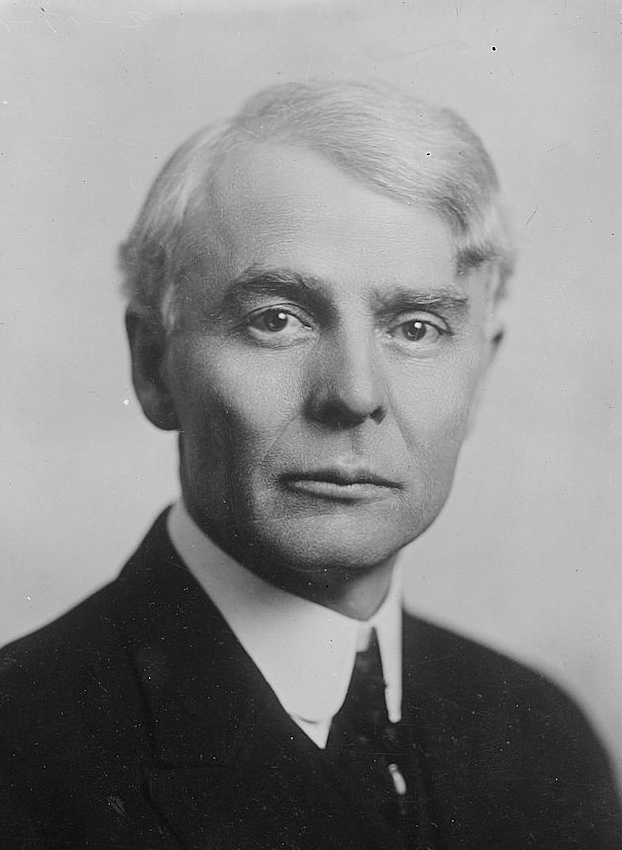
Hoover used his new position to subordinate the All-American Leagues more fully to the dictates of the bureau, which was welcomed by a good number of citizens who had tired of their ceaseless hooliganism. He directed the attention of the agency away from intellectuals and journalists and back toward the “dregs of society”, who were the true “engines of bolshevist agitation”. At Hoover’s urging, in May a law was passed giving the NBII temporary emergency powers to summarily deport alien residents as well as citizens from Japan, Germany, France, the Netherlands, Belgium, Italy, Russia, Austria, Hungary, or Bulgaria who had been naturalized in the past decade. It is difficult to avoid concluding that the mass (and likely unconstitutional) deportations of “foreign subversives” which followed were primarily intended to take the unemployed masses off the streets. Unsurprisingly, the tens of thousands of deported German and Italian Americans became some of the most ardent supporters of the new revolutionary European regimes.
There were admittedly signs that the nation was tiring of this prolonged ideological mobilization and the ever-stiffening restrictions on speech and political activism. To redress this, Root created an office of public information, which was granted not only the power of censorship but also a budget which allowed it to disperse propaganda. Working in concert with the All-American Leagues and NBII, the various Bryanist organizations were successfully shattered over the first half of 1920.
Perhaps the most vexed question for the Root administration concerned immigration and the ongoing refugee crisis. The ongoing conflicts in Europe were producing a tidal wave of “white emigres”. In one of his most controversial decisions to date, Root issued an executive order in February prohibiting authorities from turning back European immigrants fleeing political persecution. Instead, they were to be housed in temporary camps in Long Island until Congress could settle upon a resolution to the issue; more than a few Prussian aristocrats, Italian business magnates, and Austrian princes were reduced to quite miserable conditions. The fear of “subversion” was real enough, and at present, America simply did not have the capacity to employ this torrent of political refugees. Many others, however, considered it rank hypocrisy to reject these fellow anticommunist crusaders, and patriotic, middle-class elements of the German and Italian communities began to petition for them to be granted refuge. These pleas did not fall on deaf ears: Root urged congress to pass a bill permitting the emigres to apply for citizenship, and, sympathetic to this proposal, Edgar Hoover offered to use the NBII to vet the immigrants.
The anti-immigrant republican congress, however, refused to consider granting permanent asylum or citizenship to the refugees until there was a more thorough reform of the immigration system. With unemployment still over 15%, most businesses also had little interest in defending the current, more liberal immigration system. In return for transferring control of the white emigres to a special commission composed principally of NBII representatives, Root agreed to a sweeping set of immigration restrictions. Yearly numbers were capped at 100,000 a year, less than 15% the level before 1914. Asian immigrants were banned altogether, while a series of restrictive national quotas was placed on European nations which aimed to preserve the “racial stock” of the United States. The “victims of red terror” were excluded from these measures, and very quickly, jurisdictional questions arose concerning who precisely constituted a victim of terror. With his agency’s vast powers of surveillance and investigation, Hoover proved the predictable victor of this interdepartmental struggle, and soon enough all the burghers and aristocrats of old Europe were petitioning at the doors of the Federal Bureau of Investigation and Intelligence.
Confronting the Financial Emergency
Root inherited a financial crisis, spiralling unemployment, and systematic price deflation. Without a federal reserve, he had few tools to prevent a further cascading failure of the banking system. The infection spread across the first three months of his presidency, until a federal reserve bill was passed, allowing fresh money to be injected into the regional banks. This halted the monetary crisis, but the industrial one continued apace, and attempts to reopen the stock market continued to end in disaster. England’s inflationary policies had appeared to save it from the worst of the crash, but the big financiers who had propped up the banks back in November lobbied against any such expedient. Yet now, with the federal government more firmly in control of the nation’s finances and a coalition of industrialists urging the lowering of interest rates, they found themselves outflanked. While Root would not engage in a “market distorting aberration” such as public works spending, he did follow the advice of John D. Rockefeller, and interest rates were slashed to 2%. Shortly after came the gigantic navy expansion bill of May 1920, which provided a much needed stimulus for the steel industry.
In fact, the growth of the Army and Navy provided a suitable substitute for more civilian-oriented deficit spending. The next major coup came just a month into the Eastern Seas War, when Root successfully negotiated the first of the Atlantic Accords with Britain, providing America with a vital new export market. Churchill agreed to slash most of the wartime tariffs by more than half in return for a promise of future American aid to Britain in fighting the “Bolshevik revolts”. A more formal schedule of British loan repayments was also agreed upon, easing the worries of financiers. At the end of the year, Root was finally able to reopen the stock market. America was on the way to recovery, though employment still stood well over 10%, and the market remained at its lowest point since 1907.
Laying the Groundwork of a new Global System
Underlying the Root presidency was a synoptic and internationalist vision of an American-led capitalist order. It is worth recalling that Root was one of the first of the foreign policy doyen ; over his presidency, he displayed an often obsessive attention to diplomatic matters, even while he delegated domestic policy to his ultraconservative advisors. He engaged in the highly unusual move of directly attending diplomatic talks with Japan, and his secretary of state Charles Evans Hughes complained privately that his entire department had been made a “private demesne of the President”.
In its overall conception, if not its particular details, Root’s plan for an international order was not especially far off from the proposals of the Trenton Conference. He envisioned a world in which commerce, trade, and capital flowed freely between borders, informally undergirded by American industry and finance. America would serve as the guarantor of this system which, through steadily advancing human prosperity, would temper the forces of social radicalism and reactionary empire-building. Britain would be forced to give up its colonies, but only because the more general spread of the protestant virtues of thrift, industry, and self-reliance had rendered the need for “imperialist tutelage” obsolete. At last, a sort of global pacification would occur, obviating the need for an expansive military and surveillance apparatus.
The revolutions in Europe posed a very direct threat to this vision; so too, did the Japanese assault on China, which if successful would permanently compromise America’s access to the world’s largest market. The British Empire also constituted a challenge of sorts, though here Root was far more willing to engage in far more pragmatism and expediency, unlike some of his successors.
By the middle of 1920, the Republican foreign policy establishment had purged itself of its isolationist faction, but it was still internally divided between hardline, unilaterialist “internationalists” who urged a direct intervention in Europe and more anglophobic “easterners” who instead advocated war with Japan, the consolidation of control over the Chinese market, and a strangling blockade against the new socialist states. It might appear as if the “easterners” won the initial power struggle, as America engaged in a policy of brinksmanship with Japan that led to war. But even during the eastern seas conflict, this faction was never able to secure unalloyed control of the state department; reflecting the priorities of the internationalists, a considerable number of the most skilled American pilots and military advisors were sent to France, Greece, and even Croatia while the Pacific Fleet clashed with the Japanese Navy. The re-arming of the American military was stalled by the priority frequently given to ragged European paramilitaries, and in the end, the most hardline easterners were not able to achieve their goal of unquestioned American hegemony in the Pacific.
Superficially, this might appear to be a classic case of overcommitment, but there were some compelling considerations in defense of this “mixed” policy. Firstly, whereas the legitimist governments in Europe were struggling to hang onto their limited territories, America had the luxury of time in prosecuting its war against Japan, which was hopelessly overstretched in China. Secondly, an early declaration of war against Japan preempted any British assistance, which would have been more plausible without the bulk of the British army busy in India. Finally, a commitment to both theaters ensured the steady growth of the munitions and shipbuilding industries, permitting continued recovery from the economic crisis.
The war against Japan stimulated an unprecedented enlargement in the powers of the American government. Some of this built on the efforts of Bryan, who had already begun a more modest program of army modernization and expansion. More important for Root’s program was the system of national registration that was put in place with the introduction of social security, which gave the state a readily accessible database of information on its citizens. The first national draft in early 1921 used this body of data to determine who would be called up, technically acting in violation of the privacy provisions in Bryan’s bill.
The war also provided a suitable pretext to extend the emergency measures of the labor wars, even while most industrial activists were now behind bars or deported to distant shores. Additional measures soon followed, further expanding the government’s reach into the homes and lives of the average citizen. Little real resistance was offered: the NBII had succeeded in decimating the most important sources of potential opposition in civil society, and the brazen Japanese assault on the Philippines gifted a tremendous propaganda boon to the American government, which used it to mobilize popular opinion. And yet, even with the extensive growth of the American state during the Bryan administration and the first six months of the Root presidency, the nation was fundamentally unprepared for war. The navy was certainly capable enough, but the army still lacked junior officers, and it would be some time before aid could be shipped to China. It was fervently hoped that the southern half of the Philippines could be reinforced before the Japanese conquered the entire islands; otherwise, the army would have no option but to seize the western pacific islands “one-by-one” in a tortuous campaign that nobody desired…
Bình luận
0