The Red Papacy and The New Millenarianism
Of the eternal questions, nothing else: is there a God, is there immortality? And those who do not believe in God will talk of socialism or anarchy, of the transformation of all humanity on a new pattern, which all comes to the same thing, they’re the same questions turned inside out.
-The Brothers’ Karamazov, Dostoevsky
We are not, in fact, afraid of all these socialists, anarchists, atheists, and revolutionaries, he said. We keep an eye on them, and their movements are known to us. But there are some special people among them, although not many: these are believers in God and Christians, and at the same time socialists. They are the ones we are most afraid of; they are terrible people! A socialist Christian is more dangerous than a socialist atheist.
-The Brothers’ Karamazov, Dostoevsky
_Do you still ask? Is your Manchester liberalism unaware of the existence of a school of economic thought which means the triumph of man over economics, and whose principles and aims precisely coincide with those of the kingdom of God? The Fathers of the Church called mine and thine pernicious words, and private property usurpation and robbery. They repudiated the idea of personal possessions, because, according to divine and natural law, the earth is common to all men, and brings forth her fruits for the common good. They taught that avarice, a consequence of the Fall, represents the rights of property and is the source of private ownership.
They were humane enough, anti-commercial enough, to feel that all commercial activity was a danger to the soul of man and its salvation. They hated money and finance, and called the empire of capital fuel for the fires of hell. The fundamental eco- nomic principle that price is regulated by the operation of the law of supply and demand, they have always despised from the bottom of their hearts; and condemned taking advantage of chance as a cynical exploitation of a neighbour’s need. Even more nefarious, in their eyes, was the exploitation of time; the montrousness of receiving a premium for the passage of time — interest, in other words — and misusing to one’s own advantage and another’s disadvantage a universal and God-given dispensation…
Now, then: after centuries of disfavor these principles and standards are being resurrected by the modern movement of communism. The similarity is complete, even to the claim for world-domination made by international labour as against international industry and finance; the world-proletariat, which is today asserting the ideals of the Civitas Dei in opposition to the discredited and decadent standards of the capitalistic bourgeoisie. The dictatorship of the proletariat, the politico-economic means of salvation demanded by our age, does not mean domination for its own sake and in perpetuity; but rather in the sense of a temporary abrogation, in the Sign of the Cross, of the contradiction between spirit and force; in the sense of overcoming the world by mastering it; in a transcendental, a transitional sense, in the sense of the Kingdom. The proletariat has taken up the task of Gregory the Great, his religious zeal burns within it, and as little as he may it withhold its hand from the shedding of blood. Its task is to strike terror into the world for the healing of the world, that man may finally achieve salvation and deliverance, and win back at length to freedom from law and from distinction of classes, to his original status as child of God._
-Naphtha, The Magic Mountain (Thomas Mann)
Excerpts from a Swiss College-level textbook in Religious Studies, 1972
Key Terms:
_
Names used for the Fatima Church by its opponents: “White Church”, “White Papacy”, “Anti-church”, “Robber’s Church”.
Names used for the Fatima Church by third-parties: “Fatima Church”, “Fatima Papacy”, “White Church”, “White Papacy”.
Names used for the Fatima Church by its own members: “Roman Catholic Church”, “True Church”, “Fatima Church”.
Names used for the Roman Church by its opponents: “Red Church”, “Bolshevik Church”, “Anti-church”, “Jew-Church”.
Names used for the Roman Church by Third Parties: “Roman Church”, “Roman Papacy”, “Red Church”, “Red Papacy”.
Names used for the Roman Church by its own members: “Roman Catholic Church”, “Roman Church”, “Reformed Church”, “Franciscan Church”. _
Introduction
It is a trying task to write an impartial history of the great schism of 1920 and the dual papacy. We have, in fact, already sinned - such concepts as “dual papacy” and “great schism” are rejected by both of the involved parties, who vociferously insist that there was no rupture in the true body of the church, and that the very concept of a “dual” papacy is a contradiction in terms given the indivisible character of papal authority. The categories which the historian employs in this matter necessarily operate at a distance from the lived realities of the laymen, priests, cardinals and other church officials who participated in the momentous events of 1920. By abstracting, we threaten to annihilate the true nature of the conflict that tore apart the church, treating fervent conviction as mere rhetorical gamesmanship. Yet we must persist in employing such artifice, as the alternative is to write a wholly partisan history.
We should begin not with the events of 1920, but those of 1916 and 1917. While most historians have treated the Marian appirations of Fatima as something of an afterthought, or otherwise buried them beneath discussions of their varied post-schismatic interpretations, catholics of every stripe assert their centrality to the momentous events of 1920. By taking the disputants at their own word on this matter, we might better discern the era’s characteristic mood.
Beginning in the spring of 1916, three shepherd children reported apparitions of an angel in Valinhos, Portugal, a town just outside of Fátima. A little less than a year later, on April 4th, the children claimed to see five apparitions of the Blessed Virgin Mary, whom the children described as a “lady more brilliant and beautiful than the sun at morning.” The children spoke of a prophecy: prayer would finally bring an end to the great war, and for those who still doubted, a miracle would be performed on November 2nd so that “all might believe”. A large crowd of between 50,000 and 125,000 gathered in Fátima on that date, and thousands of spectators reported seeing the sun transform into the Virgin Mary. According to the children, she castigated the sins of men and implored further prayer: “the war is going to end”, Mary reportedly said, “but if people do not stop offending God, another, even worse one will begin in the reign of the next Holy Father.” All three of the children died a few years later in the global flu pandemic.
In a world without the November revolutions, these miracles would perhaps have never attained the world-historical prominence they did, though we should be mindful of the importance they already possessed during the Great War. The church had begun a formal investigation in May of 1918, and the true meaning of the events was already fiercely debated amongst cardinals and catholic intellectuals. More openly pacifist elements of the church believed that the war constituted a punishment for man’s sinful violence. In the apocalyptic atmosphere of 1919, some laymen and parish priests even suggested that the prophecies heralded the second coming of Christ and the divine judgement of the wicked conspirators who had started the war.
Of course, the November Revolutions began nearly two years to the day of the so-called “Miracle of the Sun”. There was, in fact, already speculation that the Bolshevik Revolution of November 1917 was connected in some way to the miracle; most of the church hierarchy who drew out the connection believed that the “atheistic” revolution was a warning about the dire consequences of continuing the war. This second numerological coincidence was too much to ignore. The embattled church in Rome (officially neutral, but in reality reluctantly allied to the white government) proclaimed that the revolutionary violence had been brought on by the sin of man, and that the secular elites who allowed the war to continue had now unleashed Bolshevik apostasy onto the earth by failing to restrain their lust for power. The white government in Rome had to be convinced by its clerical allies to not censor an official church statement on the matter.
Of course, the “red” Roman Church would have a quite different interpretation of the prophecies, one with long and world-altering consequences, but before racing ahead, we should examine the events of 1920 which precipitated the great schism…
The Storming of Rome and the Origins of the White Papacy
Benedict XV was declared Pope on September 6th 1914, just days after the Great War began. His political and theological instincts were as distant from his “white” successors as the “red” church: as a modernizing reformer and a pacifist, he descried the Great War as the “suicide of civilized Europe” and made numerous attempts to broker peace, at times with the assistance of the American President William Jennings Bryan. After Italy surrendered, he sanctioned Catholic participation in national politics, breaking a long taboo against engaging with the secular and frequently anticlerical Italian state. Although many of the reforming elements allied to Benedict would eventually constitute an important faction of the Roman Church, he sided tacitly with the white government even while declaring official church neutrality in the civil war.
When the red and black assault on Rome began, Benedict resolved to remain in the city as a show of force. It is still unclear why he refused to take measures to evacuate the church’s property, which the anarchists gave every indication they intended to seize. In any event, Benedict died shortly before the city was taken. He likely perished from the combined effects of influenza and stress brought on by the ceaseless artillery shelling, though considerable mystery still surrounds the circumstances of his death. The remaining cardinals, around 40% of the total that would typically meet for a Papal Conclave, rushed to elect a new pope while there was still time.The political balance was ultraconservative: montanists held at least half the seats due to the absence of more liberal cardinals from America and France. Rafael Merry del Val, the Secretary of the Congregation of the Holy Office, emerged early on as a clear frontrunner.
In certain respects, Del Val was an unusual choice: a Spaniard raised in Protestant England, he would be the first non-Italian Pope since the Dutch Adrian VI in 1522. Historically, the Italian cardinals guarded the position of the Papacy jealousy - it was, in fact, one of their few remaining privileges. However, the chaos presently engulfing Rome convinced enough Cardinals that the need for a strong conservative voice outweighed the preservation of Italianate privilege; after four rounds of balloting, Cardinal Merry del Val was officially elected. He chose the name Gregory in honor of Gregory XVII, who had triumphed over secular rule during the investiture controversy, thereby establishing sole papal supremacy over the church.
Pope Gregory XVII several hours before being elected to the papacy
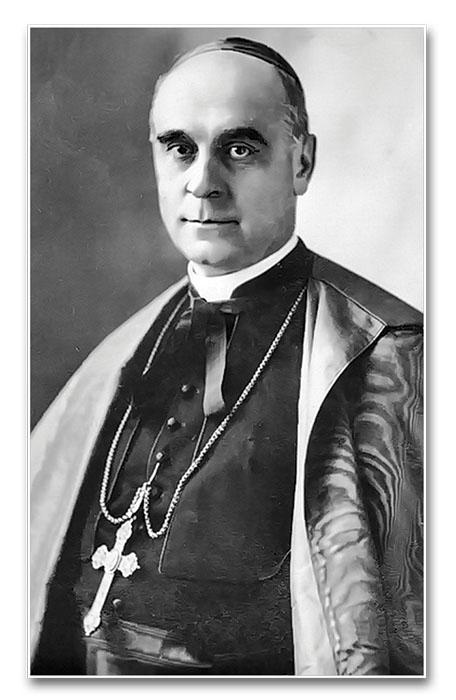
Just hours after the papal enclave, the entire church hierarchy remaining in Rome fled to Spain, principally on British vessels; the irony of Protestant England coming to the aid of the Catholic church was not lost on observers. They disembarked first at the port of Valencia, and then made their way to Madrid. The beleaguered Spanish government, however, was in no position to host a new papacy. Spanish liberals of both aristocratic and republican stripes had little desire for Spain to become the new home of the church, particularly given the ultraconservative and montanist leanings of the papacy. In fact, the feeling was mutual: despite his own Spanish heritage, Gregory wished no part in a Spain wracked by regionalist separatism, peasant protests, and social radicalism. For fairly obvious reasons, France was not a suitable destination, and though a few cardinals mooted the name of Brazil, moving this far afield was felt to reek too much of cowardice and capitulation. Portugal was the last remaining option.
The Republic of Portugal was hardly an oasis of political stability, but compared to the rest of Catholic Europe, it was comparatively quiescent. It was briefly an active participant in the Great War, but broad popular opposition to Portuguese entry led to a successful coup by military officers loyal to Sidonio Pais, one of the prime drafters of the 1911 Republican constitution. Pais never formally established peace with Germany, but he did draw down the Portuguese war effort while restructuring the Portuguese constitution to centralize power in the hands of the Presidency. Soon enough, he held significantly more power than any Portuguese monarch. Despite his own temporary masonic flirtations, he rallied conservatives to his side by normalizing relations with the church and amending a progressive law separating the church and state. He survived several assassination attempts through 1918 and 1919, which many speculated were financed by British interests upset with Pais’ pro-german outlook.
Portugal was nonetheless dependent on a flagging British economy, and as consumer demand collapsed in 1919, Portuguese export industries crashed, unemployment rose, and labor discontent surged. Pais’s government gave covert blessing to the formation of anti-leftist irmanandes, which he hoped would stymie the rising tide of worker militancy. These conservative, anti-modernist, and Catholic fraternal organizations appealed to unemployed young men of a more middle-class milieu, drawing in members with promises of brotherhood, camaraderie, and redemptive violence. They received funding from conservative Catholic landowners frustrated with being frozen out of the Republican political establishment. Pais himself was wary of the ultimate goals of the irmanandes , but he permitted them to continue operating as a useful check on the growing power of syndicalist trade unions and other left-wing political organizations.
By 1921, however, the swelling irmanandes had grown powerful enough to undermine Pais’ own authority. Fearing a coup if openly defied the church, Pais allowed the pope to take up residency in Lisbon while working behind-the-scenes to push him out of the capital. To lessen the risk of an overt conflict with secular authorities, Gregory moved his headquarters to Fatima in early 1922, where several of the fraternal irmanandes participated in the construction of a new papal complex.
Unfortunately for Pais, the decision to host the ultramontanist Pope had been the last straw for his erstwhile allies among the Portuguese Republicans, who now entered into a covert pact with syndicalist trade unions and several prominent military officers to force Gregory out of the country. Hemmed in by the irmanandes on his right , Pais did not have the ability to conciliate his former anticlerical supporters. On March 12th 1922, troops loyal to the dismissed republican general Alfredo de Sa Cardoso in the Lisbon garrison revolted and declared the restoration of the Portuguese Republic of 1911. Pais himself was finally assassinated by coup supporters later that week and with the assistance of worker-militias, Lisbon fell to the republican soldiers on the 17th.
Portugal descended into a brief civil war. In the north, royalists loyal to Henrique Mitchell de Paiva Couceiro successfully seized the city of Porto. Pais’ right-wing supporters refused to fight against the monarchists until the “Bolshevik uprising” in Lisbon had been crushed. In the center of the country, the Catholic irmanandes seized many small towns, and most of the military rallied to the side of Joao Tamagnini Barbosa and Joao de Canto e Castro, both loyalists to Pais. By the end of March, the Lisbon uprising had been crushed, but Portugal seemed as if it might be on the verge of a prolonged struggle between the northern monarchists and the remaining right-wing republicans, especially since the Catholic paramilitaries appeared set to turn on the latter.
It was in this situation that Gregory offered himself as a unifying national figure. Behind the scenes, he convinced Couceiro to accept a place in a new national government; he was likely helped by the fact that the deposed King of Portugal showed no interest in returning to the nation. The republicans lacked a single figurehead, and after some internal dissension, they settled upon Manuel Gomes de Costa, an ultraconservative officer, as the prime minister of the new administration. In reality, Gomes de Costa was hand-chosen by Gregory’s foreign minister Pietro Gasparri. Much of the temporal power in Portugal had seemingly slipped into the hands of the visiting white papacy and his loyal irmanandes without anyone being quite cognizant of it. Over the next two years, a grand new Papal residence was built in Fatima, and a telegraph line laid between the booming town and Lisbon.
The Origins of the Red Papacy
Italy was without a Pope for a little over a year. While the anarchists and significant sections of the Italian socialists opposed in principle any proposal to create a “Red Papacy”, Gramsci and his allies believed that the opportunity to create another “international organ of worker’s propaganda” was too good to pass up. A socialist papacy would also aid in the integration of the heavily Catholic south and provide the new Italian state a potent source of soft power.
The movement toward progressive Catholicism had begun on the leftward fringes of Benedict’s modernizing faction, and picked up steam through 1918-1919 as Catholics entered into parliamentary politics. The political proclivities of discontented Catholic peasants undoubtedly had a role in pushing some of the reformist clergy left. Luigi Sturzo, who considered himself a Christian Socialist, emerged as the revolutionary government’s most prominent ally, though he carefully avoided taking too active a role in the First Congress. The establishment of a rival “red papacy” gained momentum throughout 1921 as Catholics and Socialists entered into alliance and Catholic journals, periodicals, and newspapers assailed Gregory’s “reactionary and unchristian” leadership. In August, Italian parish priests and bishops formed a commission to investigate the “extraordinary circumstances” in which Gregory was elected. The same body ruled in September that Gregory’s election had occurred without providing requisite prior notice, and was therefore illegitimate. In response, Gregory issued an extraordinary decree excommunicating all of the clergymen who participated in the creation of the commission. With the break formalized, the momentum toward a new papacy was now unstoppable. The Italian bishops and priests appointed a new college of cardinals in October, which held a conclave in Rome to determine Benedict’s rightful successor.
By the time the conclave met, the majority of bishops in higher church offices had already fled to Portugal, leading to a slew of rapid promotions of lower-level priests more sympathetic to socialism. These constituted the core of the radical faction which allied itself to the new revolutionary state. Politically, they were linked to the reconstituted party of Catholic Socialists, and many of them had participated outright in the peasant activism of 1918-1919. Theologically, they emphasized the “christian duty” to struggle for social justice and a more equitable distribution of wealth. Their more outspoken members castigated the church for abandoning the prefigurative practices of the early Christian communities, in which the institutions of collective property and common ownership anticipated the coming of Christ.
Of course, they did find some support for their views in the christian intellectual tradition: they never tired of referencing the seas of ink spilled by theologians throughout the ages chastising the social elite for their abuses of the marginalized. In continuity with reformers throughout history, they argued that the upper echelons of the church hierarchy had been seduced by the “idolatry” of wealth and power, and lost sight of the Church’s true mission: to bring into being a new moral order upon the earth reflective of the Christian teachings of love, justice, and universal brotherhood. As the common radical slogan went: “Love of God is Love of Man, and Love of Man is Socialism”. The radicals advocated for a thoroughgoing reform to church doctrine which would return the Christian community to the “purity” of the Church of Saint Peter. This included, most controversially, a return to preaching in the vernacular and the direct election of priests by parishioners.
Opposed to them were the old reforming elite of the Benedictine era. They still held onto a thin majority at the conclave, and hoped to steer the church away from both the “mad ultramontanism” of Gregory and its “heretical politicization” along the radicalist line. Above all, they were fearful of aligning too overtly with the new revolutionary government and thereby harming the international reputation of the true roman church, though they were still more than willing - and in some cases, even more eager than the radicals - to carry out a purge of their traditional ultraconservative adversaries.
The moderates were, in fact, divided relatively early into two distinct camps. On the one side were the “modernists”, a liberally-inclined majority, and on the other side were dogmatically apolitical “quietests” who refused participation in temporal politics. Traumatized by the horrific violence of both the Great War and the November Revolutions, some clergymen had begun to advocate that the church should concern itself strictly with affairs of theology, and leave matters of governance entirely to the state. After all, the church had survived and thrived under political orders as diverse as Roman plantation slavery and modern capitalism; catholicism was, to use a favorite phrase, “necessarily apolitical”, adapting itself to serve the flock of any and every society. Render unto caesar what is caesar’s, and to god what is god’s.
Much more prominent at the Papal Conclave, however, were the liberal modernists. They wanted to bring the church into the 20th century, to make its doctrines and its practices adhere with the best of modern times. The modernists were perfectly comfortable launching a frontal assault against ultramontanism and conservative catholicism, which they treated as a reactionary relic of a bygone age. Their candidate of choice was Romulo Murri, who had been condemned and then excommunicated by Pope Pius X for his involvement in democratic politics.
Skirmishes had erupted between the various factions well before the Papal Conclave was called. The radicals accused the liberal modernists of being bourgeois traitors to Christ’s mission, and the quietist clergy of being “collaborators in waiting”, ready to countenance evil to preserve their own power. For their own part, the modernists charged the radicals with crypto-protestantism, and the quietists cast a pox on both of their houses. Many believed before the conclave met that Romolo Murri had achieved sufficient support to win a majority outright, but quietist dissension prevented him from doing so. The radicals, meanwhile, placed forward a number of lesser-known candidates who had little chance of garnering a majority. After fourteen rounds of balloting, the name of Luigi Sturzo was finally put forward.
Sturzo was assisted by his connections in the government, as well as by his own position midday between the two largest factions. He refrained from embracing the more revolutionary pretensions of the radicals, and advocated for a program of internal reform rather than revolutionary political action. Simultaneously, none could doubt Sturzo’s commitment to a positive vision of christian socialism. In the end, enough of the modernists believed him to be a capable steward of the reform process to swing over to Sturzo; his previous leadership of the Party of Catholic Socialists also helped him convince numerous cardinals that he could secure the non-interference of the revolutionary government in church matters. On October 29th, he was finally elected the 258th pope by the reformed Congress of Cardinals after nineteen ballots.
Sturzo assumed the name of Francis I, signaling a commitment to both social justice and catholic tradition: the Franciscan order was one of the oldest and most venerable of catholic institutions, and was well-known for advocating on behalf of the poor and marginalized. The “red pope” quickly accumulated a bustling private mythology. Perhaps the most enduring image from the Storming of Rome is that of the future Francis rushing into the Vatican at the head of the Red Army wielding nothing but a broom, beating the various gold and silver-bedecked clergymen while shouting “Auferte ista hinc!” (“leave from this place”, the command given by Jesus as he drove the money-changers from the Temple). In reality, Sturzo was over thirty miles of Rome during the conquest of the city, and he did not enter it until some weeks later, but this has not stopped the story from entering popular consciousness.
Francis I (nee’ Luigi Sturzo) in 1905 following his ordination
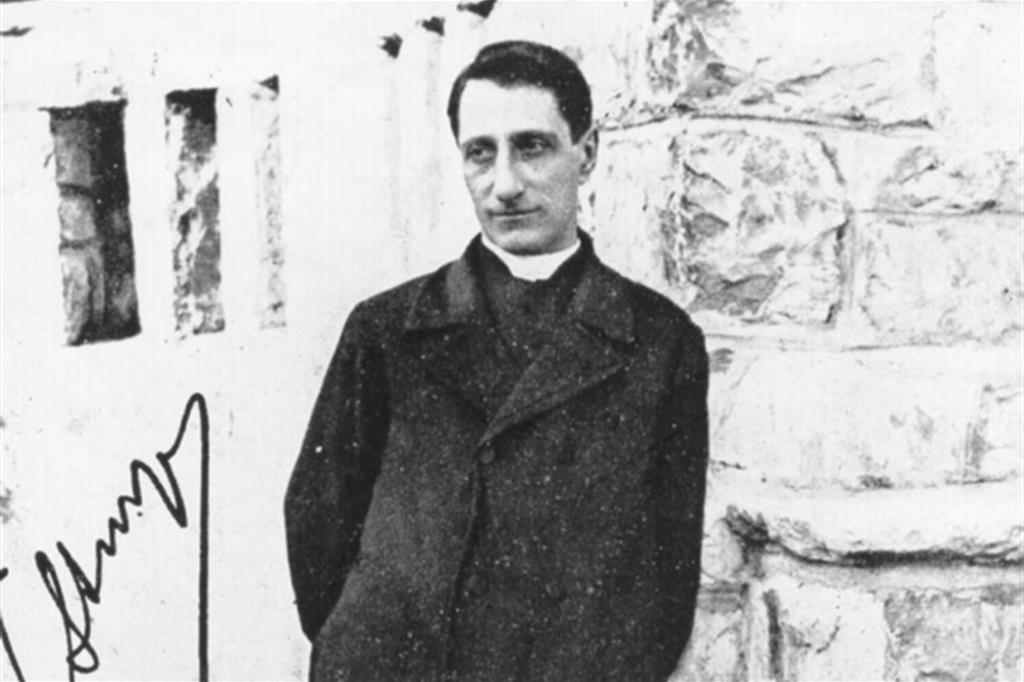
Francis also became known for his “day walks”, where he would eschew his formal papal vestments and stroll through the streets of Rome clad in ordinary dress; in the mid-1920s, these became something of a public event as crowds thronged around the ambulatory pope. Francis was a robust and lively interlocutor, and he became well-known for his ability to discourse on arcane theological matters without breaking his stride. His temporary parishioners included many anticlerical socialists who made the “pilgrimage” primarily to challenge the most “Holy of “holies”. Perhaps the most iconic photograph of the era depicts Francis I embracing a young anarchist radical who had minutes ago been on the verge of assaulting him.
The Duelling Papacies and the New Millenarianism
In the month following Francis I’s election, the varied elements of the Catholic world declared their allegiance. Loyal bishops in Germany, the Netherlands, and parts of Northern France recognized Francis I as the legitimate pope and called on Gregory to step down. Meanwhile, across South America, Croatia, Poland, and America, existing Catholic hierarchies declared the “Communist Agitator” an antipope. A much longer war of position commenced in the various catholic orders; sizable minorities of lower-ranking Jesuits and Franciscans left to form new, reconstituted organizations loyal to the Roman church. Curiously, in America many bishops and cardinals expressed reservations about the “politicization” of the church hierarchy in Portugal, while in many locations across South America, parish priests and laymen were considerably less enthusiastic about the Fátima papacy than their superiors, a division which would eventually lead to a prolonged battle for control of the continent’s catholics.
Throughout 1922, the two popes directed a series of biting encyclicals against each other. Francis I denounced the ultramontanist monarchism of the “white church”, as well as its growing intervention in the temporal affairs of Portugal. Echoing some of the quietists, he appealed to the primarily spiritual character of the Church’s vocation. He also made a brief defense of the new “communal economics”, though he never outright equated Catholic Social teaching with Marxism. For his part, Gregory accused Francis of being a mere puppet of the socialist bloc and of perverting the traditional teachings of Catholicism.
The Fátima Apparitions quickly became the central subject of dispute in the warring encyclicals. This is perhaps unsurprising given Gregory’s decision to locate the new Papacy in Fatima, but it was Francis I who first raised the matter in the (in)famous “Maria, Redemptor Hominis” (Mary, Redeemer of Man) encyclical. This remarkable piece of eschatology is, of course, one of the most discussed theological texts of twentieth-century Catholicism. It was written at a time when Francis was under increasing pressure from the ascendant radicals, and it appears, in fact, as if several left-wing Catholic intellectuals of the Naples circle had a hand in writing it. Though tempting, we should be careful to avoid over-emphasizing the role that this encyclical played in the events which followed, for the ideas, feelings, and convictions which it articulated were already very much “in-the-air” well beyond Italy. Nonetheless, it undoubtedly played a vital part in crystallizing these sentiments and in granting them official sanction, something which successfully enraged the moderate faction of the clergy, who believed that in agreeing to Sturzo’s papacy they had guaranteed themselves sufficient political leverage to prevent such politico-religious utopianism from becoming official church policy.
Maria, Redemptor Hominis centered on the interpretation of the Marian Apparitions of 1917. In a drawn-out analogy, Francis likened the Marian auguries to Christ’s prophecy of the Second Temple’s destruction. The “offenses to god” Mary spoke of in 1917 were none other than the exploitation of man by man, the spoliation of the earth, the accumulation of private wealth, the depredations of war, and the systematic substitution of hierarchical “relations of submission and slavery” for “properly christian relations of brotherhood and love”. In sum, it is bourgeois society which is indicted as a “social” sin, and the outbreak of revolution simply the natural and divinely-ordained consequence of such sin assuming monstrous and nearly irremediable proportions. Like the destruction of the Temple before it, the violence of war and revolution, while tragic, were both necessary and divinely predetermined waystations to man’s ultimate salvation. At least implicitly, the revolutionaries were depicted as Christian martyrs, even if, as Francis coolly remarked, “many were imperfect agents, practicing the wickedness and cruelty that they suffered, and even more failed to recognize the signs of the Creator reflected in their own burning desire for justice”.
One may contrast Francis’ reading of the Martian apparitions with an even more radical interpretation that arose among the “prefigurationist” catholic intelligentsia of Naples. For the prefigurationists, the only means of ushering Christ into the world was to first establish a “replica” of the Kingdom of Heaven upon earth. Only after the achievement of Gemeinwesen, the “true community” in which man’s inhumanity to man is brought to an end, will Christ find human beings truly worthy of salvation. The Martian Apparitions were nothing more than omens that this community was on the verge of being constructed. They therefore had a distinctly eschatological role. Of course, Francis did not offer a plan for achieving the Kingdom of God in Maria, Redemptor Hominis, though he did endorse the notion that the apparitions were signs of a coming change in the fundamental character of human social relations. Without worrying overmuch about a “close reading” of the text, the radicals therefore chose to embrace it as a reflection of their own prefigurative political theology, a charge which Francis studiously refused to either endorse or repudiate.
The Angel of Socialism Takes Flight
Beginning in the 1920s and extending well into the 20th century, various forms of socialist-inflected Marian millenarianism spread across Pacific South America, the Dutch East Indies, Northern Vietnam, Central Africa, and Korea, posing challenges for colonial rule and mobilizing traditionally insular peasants against both native and foreign elites. The Marian apparitions followed a fairly uniform pattern despite their diverse trappings. Either a group of peasants or a charismatic religious leader would claim to see and speak with a divine image of a matronly woman, typically in her late 20s to early 40s; she implored those who listened to gather those closest and ready themselves for the coming of a new world in which the wealthy and powerful would be made humble and the common people exalted. The task of bringing the new world into being was pictured as an active and strenuous vocation, requiring the full employment of human agency. Whether this was to occur through violence, religious reform, or mass conversion was a matter determined on the local level.
In analyzing this extraordinary outburst of world-wide religious fervor, we must be careful to avoid the Eurocentric fallacy which attributes sole agency to the Roman Church. This trope has become quite ubiquitous in the popular histories of Marian-socialist millenarianism and yet there is extraordinary little historical evidence for it. Its staying power is a testament to the interest of both socialist and conservative historians in casting the Roman Church as the ultimate and unique originator of such religiously-inflected resistance to colonial rule. In reality, Marian Millenarianism arose exclusively in areas which already possessed pre-existing traditions of eschatological utopianism. Although it frequently crossed denominational lines, particularly among protestants, it was almost never transplanted into wholly foreign religious contexts. Local circumstances and traditions lent a unique character to each indigenous reworking of prophetic Marianism; the “glorious future” envisioned rarely coincided exactly with the imagined utopia of European socialists.
Among the peasants of Java, apparitions of a “great mother” foretold the coming of a “just king” who would expel the Dutch, eliminate the rent upon land, and end the exploitation of Chinese traders. In Central Africa, Eliot Kenan Kamwana, a charismatic religious leader who had already amassed a substantial following in the pre-war years, announced that he had escaped from British imprisonment in Mauritius with the help of a “white lady of the church”. She had promised to meet him in Nyasaland, where she would bring about a kingdom of endless abundance and amity once the people had risen up against the British. Korean preachers spoke of “working toward God” with the assistance of a kindly female spirit, who would end all temporal government, slay death itself, and divide up the lands of the wealthy amongst the peasants after the people had fulfilled Christ’s mission.
Mary the Angel of Socialism, Paul Klee
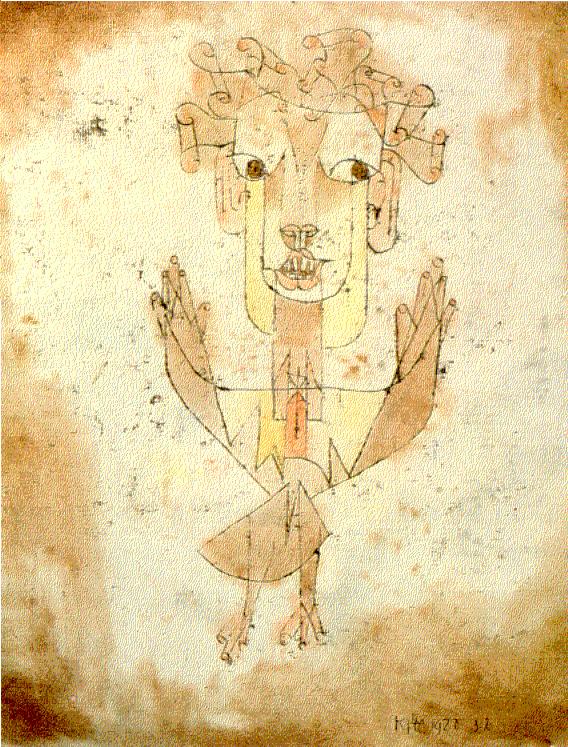
It is undeniable that the Roman Church had a hand in these movements. They fervently disseminated their own particular interpretation of the Marian apparitions, and among the downtrodden people of the third world, it was the radicals’ activist, ultra-millinerian reading which was shared. It appears that the Italian government, too, bears a significant degree of responsibility: for many years, the Manchester Guardian report detailing extensive payments to the Roman Church from socialist-controlled Camera del Lavor
was dismissed as British propaganda, but now the story has finally been confirmed by a number of Italian priests.
It was ultimately none other than the Italian Chairman Antonio Gramsci who was behind these payments. As his declassified notebooks revealed, Gramsci believed that the Roman Church could serve as an invaluable international propaganda arm of the socialist bloc, and he directed loyal chambers of labour to direct some of their savings into the Franciscan and Jesuit missionary orders. However, the independent-mindedness of the zealous young radicals meant that in practice, Gramsci never possessed much control over how these funds were actually spent. The missionary orders took on a life of their own, and soon enough operated outside the purview of the Pope as well as the Italian government. It was in this freewheeling atmosphere that the “Marian prophecies” were spread, though it appears that most of the “work” done here was accomplished not by the radicals themselves but the expanding communications networks of colonial capitalism and learned native elites, often in the employ of colonial governments, who were eager to assimilate and advance anti-hegemonic versions of Christian thought. Direct attempts to secretly teach the new “theology of liberation” to Javanese peasants or Central African villagers rarely resulted in a conversion to “orthodox” Catholic-Socialism, however well-meaning and genuine the effort. Instead, existing religious movements fused the more overtly symbolic concerns of their traditional millenarian practices and the politicized utopianism of the red catholics, resulting in a myriad range of political theologies that collectively exercised a vital role in fomenting the development of national and anti-colonial consciousness.
Notes
I want to thank @PrognosticHannya for helping brainstorm ideas for this post, and in many cases giving me an education about church history and popular catholicism! This entry is at least as much their doing as it is mine.
Bình luận
0