Red Republic: The Political and Institutional Foundations of the New Italy
Lenin asked Borghi if he were opposed to the Centralism of the Bolsheviks, to which he replied: “You have that right. How could any anarchist be in favour of Centralism”? To which Lenin retorted: “Freedom cannot be the death of the revolution.” Borghi countered with: “In the absence of freedom, the revolution itself would be a horror.”
-Conversation purportedly overheard at the 1st meeting of the International Union of Revolutionary Marxists
Anarchy is synonymous with Socialism. Because both signify the abolition of exploitation and of the domination of man over man, whether maintained by the force of arms or by the monopolization of the means of life.
-Enrico Malatesta
The point of Modernity is to live without illusions without becoming disillusioned.
-Antonio Gramsci
Excerpts from Aurelio Chessa, Italy: Liberal Kingdom to Socialist Republic(Rome, 1964)
Much like its more populous counterpart to the north, the institutional structure of the Italian polity was determined both by the failures of the bourgeois state which preceded it and by its particular configuration of revolutionary forces. These were far more plural than in most other socialist states. The Italian Socialist Party never held anything close to a monopoly of working-class support, and in the prewar era, only a small fraction of the working-class was affiliated with socialist-aligned trade unions. War contributed to an extraordinary growth in their membership, but in relative terms, they were outpaced by the syndicalist USI (Unione Sindacale Italiana). In the year and a half-long period preceding the November revolution, non-marxist radicals successfully outflanked the socialists, and a wave of workers defected from the traditional socialist unions. Ousted from its position of hegemony in the Italian left, the socialists were forced to conciliate with other tendencies; as the most outspoken proponent of such a strategy, leadership of the party fell to Antonio Gramsci in the summer of 1919.
The platform endorsed by the Gramscians emphasized the worker-councils as the basis of the revolution, and called for permanent industrial militancy to win worker’s control of production. Here, the policy of the “broad worker’s front” was first explicitly formulated; the vanguardist party would collaborate with all truly proletarian social forces if their interests aligned. The ultra-left Bordigists reluctantly agreed to these measures: they were conscious that it had thus far been the anarchists and syndicalists who had acted as the advance spearhead of the worker’s struggle, and were chastened by this realization into temporarily adopting a strategy of collaboration.
Liberal Italy was in a terminal state of crisis, with its cabinets recycled on a monthly basis and its leaders casting bitter incriminations at each other. The grand nation-building project of the Italian Liberals, the project of risorgimento, had ended in a humiliating treaty which permitted the indefinite occupation of Venetia by Austrian soldiers and forced the Italian state into harsh financial austerity to pay for reparations. Fiscal retrenchment meant that any efforts to forge a social peace were likely doomed in advance.
In this situation, it is perhaps unsurprising that Gramsci’s “broad front” soon encompassed significant sections of the middle-class and rural population. Tepid efforts at land reform were not sufficient to placate the peasants of southern and central italy, and reformist attempts to negotiate wage-disputes merely exacerbated rising inflation. Over the summer, rural unrest in Central and Southern Italy exploded as peasants took it upon themselves to expropriate the estates. Middle-class elements and demobilized soldiers disillusioned with the liberal order flocked to revolutionary syndicalism.
The November Revolution turned the social war into a civil one. The “industrial triangle” of Milan, Genoa, and Turin fell to the revolutionaries in the first week of fighting. Anarchists in Apulia and Central Italy wreaked havoc on white supply lines. Gramsci’s broad front policy was reaffirmed when the leaders of the nascent revolutionary state met in Milan and agreed to merge their assorted militias into an army, though Malatesta’s “black brigades” largely fell outside the unified chain of command.
There was also the matter of the catholics. The Catholic Popular People’s Party, formed in 1918 to contest the parliamentary elections, had won broad support amongst the smallholder peasantry in Central and Southern Italy. Many genuinely revolutionary elements of the body politic could be found in its rank-and-file. Even before the revolution, mid-ranking party activists were already advocating for a tactical alliance between left-catholics and socialists. Yet the party leadership had ties to the Vatican, and was predictably of a more conservative bent. The right-wing, led by Alcide de Gasperi, denounced the revolutionary upheaval and supported the legitimist government. The party left, however, refused to take sides in the civil war, declaring a “pox on both their houses”. When the anarchist army marched on Rome, in a bid to prevent the outright destruction of the catholic church bureaucracy, the left-wing priest Luigi Sturzo declared his support for the revolutionary government. He was soon joined by Ernesto Buonaiuti, Romolo Murri, and Giorgio La Piana.
While the anticlerical anarchists and ultra-left bordigists were naturally united in opposition to catholic participation in the revolutionary government, the other factions took a more pragmatic approach. Gramsci favored an alliance with the catholics, not least to sideline the increasingly influential anarchist faction of Armando Borghi, which controlled the powerful USI. Mainline syndicalists led by Alceste De Ambris were willing to tentatively welcome the catholics into the fold on the condition that a new papacy be installed. However, the provisional executive committee remained deadlocked on the issue until the mass peasant revolts in 1921 convinced them of Sturzo’s loyalty to the revolutionary project.
The Ideological Camps of the Early Republic
By the end of the Civil War, at least five distinct ideological tendencies had emerged with unique power bases and leaders. Firstly, there was the revolutionary socialism of Gramsci, situated in the new center of the Italian Socialist Party. This workerist form of council-communism most closely resembled the right-wing, pragmatist wing of the German Luxemburgists, though they retained a somewhat more libertarian outlook. The Gramscians desired a unitary state run by delegates from worker’s councils. Contemptuous of revisionists and radicals alike, they believed in a steady path toward socialism which would involve a mixture of economic planning and market incentives. Generally speaking, Gramscians favored building as broad a tent as possible, but were skeptical of the ultra-radicalism of anarchists and bordigists. They were distinguished from other parties of the “new European centre” by an especially assertive and thoroughgoing embrace of proletarian internationalism. The counteroffensive of socialist trade unions in early 1921 won the Gramscian faction a plurality at the initial all-Italian congress of worker and peasant’s delegates, but they found themselves outmanuevered by an unexpected coalition of opponents. Nonetheless, the Gramscians would be key players in all of the early governments of the republic.
The next largest faction were the anarchists of Armando Borghi and Errico Malatesta. Despite Malatesta’s influence as a theorist, it was Borghi, as general secretary of the USI, who occupied a dominant position. Borghi also demonstrated a greater degree of pragmatism, especially in his willingness to work alongside the socialists and even, at times, the catholics. The close relationship between the two men likely delayed an inevitable split, but there were more than a few anarchists who accused Borghi of being a closet syndicalist from the very beginning of the Italian Worker and Peasant’s Republic.
The anarchists, of course, favored a highly decentralized political system, and sought from the very beginning to strip the federal government of its powers. They also pushed particularly firmly for a national militia to replace Italy’s army, a highly popular policy which nonetheless ended up having disastrous consequences for Italy’s military readiness. In short, the anarchists left an enduring imprint on the politics of Italy, and a number of the main differences with the German and Soviet systems are directly attributable to their influence.
The “third force” of the early republic were the catholics. The remaining political factions, such as the right-wing syndicalists, ultra-left bordigists, and the rump of the reformist and left-centrist socialists were inconsequential compared to the “big three” (catholics, socialists, and anarchists). The reconstituted Catholic Popular People’s Party named itself the Union of Catholic Socialists, and allied itself to the new red papacy in Rome. The beleaguered catholics became some of the staunchest defenders of traditional liberal rights, which they considered the main bulwark against left-radical anticlericalism. They also frequently aligned with the anarchists on issues of regionalism and federalism. Opposed to both cultural revolution and workerist conceptions of socialism, they were natural reformists and incrementalists; many of the welfare programs of the republic’s early years were formulated either by catholics or in cooperation with them. They were especially popular in rural areas and among women and the elderly. Despite their quite genuine support in the country-side, the catholics were the political bloc most frequently in the minority, and it took some time before they could credibly rebut allegations that they were a counterrevolutionary fifth column.
Situated at the opposite end of the spectrum were the followers of Amadeo Bordiga’s ultra-left communists. They held off on splitting with the socialists - who soon renamed themselves the Italian Party of Revolutionary Marxists - because they lacked support in the broader trade union and council movement. This would eventually change, but initially they operated as a pressure group on Gramsci’s left, checking his penchant for opportunism. Calls for a revolutionary reorganization of the Italian economy and the introduction of Luxemburgist-style central planning were unable to make much progress, though they had more success as early proponents of European Federalism. Their clout grew considerably as Bordiga’s ideas spread across Europe and a new generation of intellectuals grew critical of the perceived sclerosis in the Gramsci ministries. The Bordigists also resolved to carry out a “decisive break” with the anarchists, which principally meant shattering the power of the USI and using the power of the state to crack down on anarchist organizing. Gramsci shared their distaste for the anarchists despite his “broad front” policy of 1919, but was unwilling to employ such radical measures against the opposition. Of course, Bordiga’s proposals were unacceptable to many in the republic who accepted anarchist participation in the political system as a given, but he did find some unexpected allies among the right-wing socialists. It is to them we now turn.
The socialist reformists and previous syndicalist leadership of the USI found themselves in a similar situation in 1919: tarred for their support of the war, banished from their positions of power, and overrun by previously marginal leftist radicals. Right-wing syndicalists such as De Ambris found some success in mustering up patriotic outrage against Austrian reparations, but his calls to restart the war were met primarily by laughter and derision. Reformist and left-centrist socialists, meanwhile, found themselves utterly out of touch with the mood of the rank-and-file; their complete loss of support amongst party activists doomed their position in 1919. Each group sent disappointingly small delegations to the All-Union Congress, and in an effort to shore up their numbers, they entered into cooperation. Gramsci finally expelled the right-flank in late 1921, shortly after the conclusion of the Third Internationale; unable to wrest back control of the USI, the syndicalists joined them in a small grouping of “Socialist Republicans”. Though initially tiny and powerless, they won increased support in the next few years as middle-class participation in the new regime rebounded. Ideologically, they adhered to a corporatist version of Mazzinian Republicanism, and were consistently the most bellicose and jingoistic section of the All-Italian Congress. Their wish for a war with Croatia was eventually fulfilled, though the government was less willing to commit to its extensive plan of annexations.
The 1st All-Italian Congress and the Drafting of the Basic Law
In the summer of 1921, the first All-Italian Congress met in the provisional capital of Turin to draft the basic law of the new republic. The decision to host the congress here, in the northern stronghold of socialist unionism, had been an early victory for Gramsci, but he was to quickly find himself outmaneuvered by the opposition. In a historical irony that recalled Hegel’s “cunning of reason”, Gramsci’s own attempt to bring the catholics into the political system to limit anarchist power had precisely the opposite effect. Of course, the alliance which brought together Catholics and Anarchists was not to last; it was broken later that year, in fact, when Gramsci invited the Catholic Socialists into government. But it would have an enduring impact on the political institutions of the new republic.
Composition of the First All-Italian Congress
| Party/Faction | Delegates | % |
|---|---|---|
| Italian Socialist Party (Gramscian) | 272 | 32 |
| Italian Socialist Party (Bordigist) | 34 | 4 |
| Italian Socialist Party (Right-wing) | 25 | 3 |
| Anarchists | 238 | 28 |
| Union of Catholic Socialists | 204 | 24 |
| Revolutionary Syndicalists | 76 | 9 |
There were some crucial points of consensus. The vast majority of delegates agreed that they could not repeat the “German mistake”, which was heartily mocked by participants of every ideological stripe as typical teutonic excess: what manner of madman would enshrine dual-power as a positive principle of government? Of course, the Italians had their own problems. Even though they agreed on the need for a “pure” council republic, the councils were not nearly as widespread in Italy as elsewhere; trade-unions, in fact, had expanded at a faster clip than the councils themselves, owing largely to the weakness of the Italian state in regulating and suppressing them. Yet the Gramscians, anarchists, and bordigists alike denounced the notion of making the trade unions the basis of the new polity. Even the syndicalists weren’t overly enthused by the idea; after all, they had lost control of their own unions to the anarchists!
Eventually, the delegates settled on a compromise solution: the new basis of the state would be the Camera del Lavor. These “Chambers of Labor” were originally affiliated with the main socialist trade union, the CGT, but they quickly grew into autonomous organizations. They became centers of social life for working-class communities, and also disbursed funds and assistance to strikers. Typically, leadership of the regional chambers was determined both by the composition of nearby unions and the dominant tendencies of local left-wing organizers. The chambers coordinated the massive protest wave at the beginning of the Great War, and were increasingly run by anarchists and syndicalists.
The Congress planned to fold regional administrations into the Camera del Lavor, and establish new ones where necessary . The Camera would also be responsible for appointing delegates to the All-Italian Congress, which would act as the supreme legislative body for Italy. This legislative body would directly appoint an executive, much like in the German system. Each Camera would have its leadership determined by votes in local trade unions, peasant leagues, worker-councils, and municipal committees. The first three would vary in proportion to the workers present in each, while the latter would remain fixed at 30%.
This solved the most basic issue of institutional design, but disagreements persisted about the true role of the Camera. The anarchists wanted to miniaturize and empower them, and proposed establishing hundreds of new chambers of labour across Italy to ensure an unbreakable connection between workers and the new bodies; naturally, the Gramscians considered this a recipe for chaos, and instead envisioned them as little more than regional councils which would appoint delegates to the all-important All-Italian Congress. When the catholics joined the anarchists in vetoing the Gramscian proposal, it became clear that it did not have the necessary support. It now fell to the opposition to sketch a robust alternative.
What emerged was, of course, a compromise. The Chambers of Labour were to take on a crucial administrative-political role in governance, but certain essential functions would remain the purview of the All-Italian Congress. While additional Chambers would be created, they would act as engines of regionalism rather than localism. Each Camera would be allowed, within limits, to determine its own composition: with the approval of a democratic, region-wide vote, a chamber could choose to reduce or to increase the share of members appointed by municipalities. They would also be empowered to recall appointed delegates and call elections at any time of their choosing.
The Central Government’s freedom of maneuver was hamstrung by the federalist basic law. In order to engage in large-scale economic planning, cultural revolution, or any other “grand project”, it would need to secure the assent of key Chambers of Labour. This arrangement certainly helped create a federal government uniquely attentive to the needs of particular regions, but it also likely contributed to a certain tendency for deadlock and institutional inertia in the early republic, which would only be fully resolved with later reforms which revised the balance of power between the camera and the central government.
Nonetheless, the libertarian and anti-statist proclivities of Italian worker’s culture left a lasting mark on the basic structure of the Italian polity. The “cooperative federalism” of the Italian system persists into the present, and has recently become a model for new socialist states with highly uneven regional development and significant populations of national minorities. Today, Italy’s council and trade union elections have the highest participation rates in the entire socialist sphere, and more Italians serve in government at some point in their life than in any other nation on earth. Political scientists attribute this to Italy’s wide-ranging institutions of participatory democracy, as well as to the continuing importance of municipialism and regionalism in Italian political culture.
Camera Del Lavoro Elections and the First Gramsci Ministry
The 1st Congress of the Republic dispersed after adopting the basic law. Over three months, an additional twenty-five Camera del Lavor were established - at first, many of them were little more than rechristened administrative buildings. Elections were delayed until the end of the Third International, and took place amidst another feverish socialist campaign to win back the industrial laborers who had defected to anarchist and syndicalist unions. Gramsci had made it his mission to force the anarchists into a purely ancillary role. The policy of the “broad front”, which sanctioned a temporary alliance with the anarchists to achieve revolution, ceased to apply now that proletarian power had been secured.
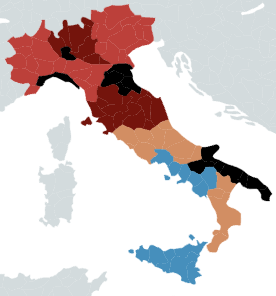
Despite the best efforts of the socialists, however, Borghi and Malatesta’s anarchists won a little over a quarter of the delegates to the 2nd Congress, and also achieved outright victories in the camera of Genoa, Apulia, and Romagna. To form a national government which excluded the anarchists, Gramsci was forced to enter into coalition with the catholic-socialists, something which had already been accomplished in the regions of Lazio and Umbria. This was perhaps the natural culmination of Gramsci’s voluntarist version of Marxism: long an opponent of “free thought”, “naive positivism”, and the entire tradition of Italian liberal anticlericalism, Gramsci now forged the first “alliance of hammer and crucifix”.
Control of Italian Chambers of Labour
_Light Red: Socialist
Dark Red: Socialist/Anarchist Coalition
Black: Anarchist
Orange: Socialist-Catholic Coalition
Blue: Catholic_
The new government’s first task was the rationalization of economic life. For Gramsci and the socialists, this principally meant formalizing the worker’s “prefigurative” institutions as the new basis of the economy. The most important of these were the producer’s cooperatives and the factory committees. Revolutionary expropriations were given a legal basis, and the producer’s cooperative made the primary unit of the new economy. In a rare show of unity with the Camera, Gramsci agreed to concentrate tremendous financial power in a network of community and municipal banks controlled by the chambers of labour; these would still, however, need to compete for grants from a central bank.
Gramsci was a critic of the statist socialism embraced by Luxemburg and the Bolsheviks. While Lenin believed that the cartelization of the wartime German economy paved the way for socialism, Gramsci argued that the massive industrial agglomerations of the 1910s represented a step back for worker’s power. Markets were necessary tools to calibrate prices, though systematic guardrails must be instituted to limit their more corrosive effects and restrain the hegemony of “market-logic”. Hence producer’s cooperatives were allowed to buy and trade with one another, but were also subject to the control and sanction of their Camera del Lavor; in practice, this meant that economic planning, when it occurred, happened at the regional and local level. Enterprises which desired capital were required to prove the “use-value” of their products to local communities; unsurprisingly, this soon created complicated relations of patronage, though it did have the effect of limiting overly speculative businesses and ensuring close links between cooperatives and the municipalities they served.
Italy’s new government also pushed for closer economic and political relations with its more thoroughly industrialized northern neighbor. Britain, Italy’s main commercial partner since the Risorgimento, did not institute any explicit embargo, but the supply of most key British imports nonetheless mysteriously “dried up” in 1920. German coal allowed Italian industries to continue functioning, but these purchases came at a heavy cost. Gramsci, long influenced by the “free trade socialists” of the 19th century, hoped to regularize interstate commerce by entering into a customs union with Germany, and even mooted the building of a new railway through the alps. These endeavors were supported by an unusually large proportion of the Italian body politic: Bordigists, Anarchists, and even Catholics were interested in pursuing European confederation. It thus represented a natural avenue for the new government to explore: here, political capital could be won rather than expended.
At first, there was resistance to the idea in Germany. Having already established close economic ties with the Soviet Union, some in the Revolutionary Worker’s Front worried that the confederative project would flood Germany with cheap consumer goods, harming local industries. Italy was also far less willing to accede to military cooperation, which was the main demand of the Germans; the deeply antimilitarist tenor of Italian politics at the time was only partially matched in Germany, and the catholics and anarchists in particular worried about being drawn into a new global war. Halting, incremental progress was nonetheless made: in 1922, a trade deal was signed removing tariffs on most heavy-industrial goods, and in 1923 the first set of new transalpine railway lines were laid in Venetia and Tyrol. The foreign ministers of Germany, Italy, and the Netherlands signed a memorandum in early 1924 expressing their commitment to creating a common market - this was perhaps the first real step toward European Federalism, though it was only the beginning act of a long saga.
Notes
I want to thank @PrognosticHannya for helping me brainstorm ideas for this post, especially regarding the red papacy and left-catholics.
Bình luận
0